The Huyck Bain Crandell Collection, Document HBC004
< Next Earlier Document — Next Later Document >
1828-03-15 Report, on Regulation of Pressed Hay
Report of the select committee, relative to the regulation of the packing and sale of pressed hay.
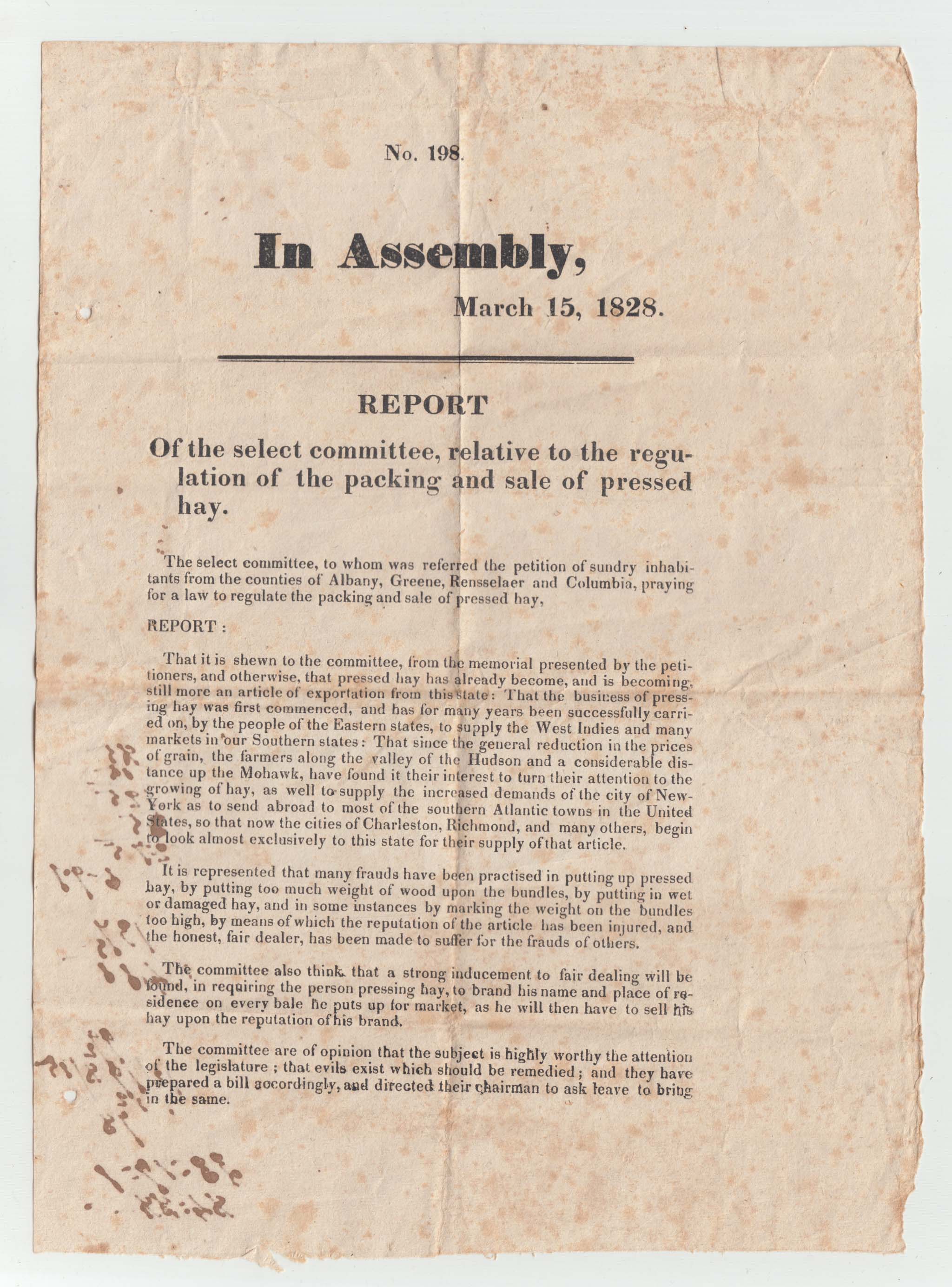
Image: HBC004 obv.jpg
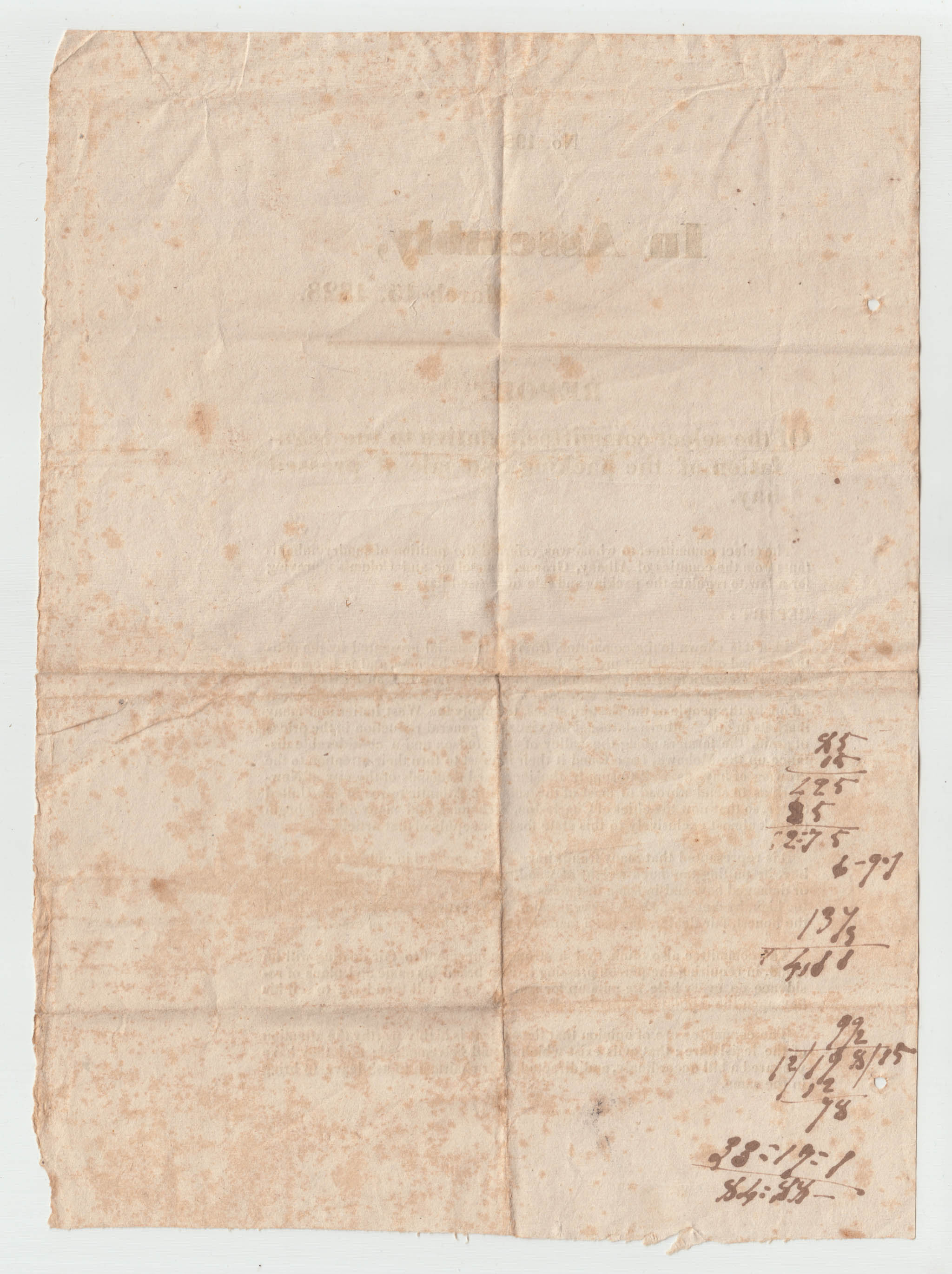
Image: HBC004 rev.jpg
Transcription
Obverse
No. 198
In Assembly,
March 15, 1828.
REPORT
Of the select committee, relative to the regulation of the packing and sale of pressed hay.
The select committce, to whom was referred the petition of sundry inhabitants from the counties of Albany, Greene, Rensselaer and Columbia, praying for a law to regulate the packing and sale of pressed hay,
REPORT:
That it is shewn to the committee, from the memorial presented by the petitioners, and otherwise, that pressed hay has already become, and is becoming still more an article of exportation from this state: That the business of pressing hay was first commenced, and has for many years been successfully carried on, by the people of the Eastern states, to supply the West Indies and many markets in our Southern states: That since the general reduction in the prices of grain, the farmers along the valley of the Hudson and a considerable distance up the Mohawk, have found it their interest to turn their attention to the growing of hay, as well to supply the increased demands of the city of New York as to send abroad to most of the southern Atlantic towns in the United States, so that now the cities of Charleston, Richmond, and many others, begin to look almost exclusively to this state for their supply of that article.
It is represented that many frauds have been practised in putting up pressed hay, by putting too much weight of wood upon the bundles, by putting in wet or damaged hay, and in some instances by marking the weight on the bundles too high, by means of which the reputation of the article has been injured, and the honest, fair dealer, has been made to suffer for the frauds of others.
The committee also think that a strong inducement to fair dealing will be found, in requiring the person pressing hay, to brand his name and place of residence on every bale he puts up for market, as he will then have to sell his hay upon the reputation of his brand.
The committee are of opinion that the subject is highly worthy the attention of the legislature; that evils exist which should be remedied; and they have prepared a bill accordingly, and directed their chairman to ask leave to bring in the same.
Reverse
A few calculations.
Commentary
Notes:
- Why this document is in the archive — Peter H. Bain or a family member kept this Assembly report because it directly affected their commercial interests. The Pomponick farm in the Hudson Valley was exactly the kind of operation described — farmers along the Hudson valley turning to hay production as grain prices fell, supplying New York City and southern markets.
- The commercial context — the report perfectly describes the agricultural transition visible in the archive’s later documents. The shift from grain-dominated accounts in Jacobus’s first account book to the more diversified farm production of Elizabeth’s second book, and now hay as a major commercial crop, reflects precisely the economic changes the committee describes.
- “Since the general reduction in the prices of grain” — explaining why the Huyck/Bain farm moved away from the large corn and grain sales that dominated the first account book toward diversified production including hay, butter, cider, leather, and wool.
- “The valley of the Hudson and a considerable distance up the Mohawk” — the Kinderhook area squarely within the described region.
- “Charleston, Richmond, and many others begin to look almost exclusively to this state” — the pressed hay trade connecting Columbia County farms to southern markets, a significant commercial development.
- Fraud provisions — requiring the presser to brand his name and residence on every bale — a consumer protection measure reflecting the more regulated commercial environment of the early American republic compared to the informal credit economy of the colonial period.
- March 15, 1828 — Peter H. Bain in his prime farming years, the Pomponick operation presumably engaged in hay pressing for market.
The document being preserved suggests Peter H. Bain or a family member followed legislative developments affecting their business — a more politically engaged farming family than the colonial Huycks whose world was largely local and Dutch-speaking.
A fascinating piece of agricultural and economic history preserved in a family archive — exactly the kind of document that gives context to the farm’s commercial evolution across the generations.
Hay Pressing in 1828
In 1828 hay pressing was entirely mechanical, using horse or human power:
The basic hay press of this period was a simple lever or screw press — a wooden frame with a large screw mechanism driven by a long lever arm, with horses walking in a circle to turn it, or men operating it directly. The hay was packed into a wooden box or form, compressed by the screw, then bound with wooden boards and iron or rope ties into a bale.
The process:
- Hay was loaded loose into the press box in layers
- The screw was turned to compress it — a full bale might compress four to five times the loose volume
- Wooden slats were inserted through slots in the press box to hold the compressed shape
- Iron hoops or heavy rope were tied around the bale to secure it
- The press was released and the bale removed
The fraud problem mentioned in the report makes sense in this context:
- “Too much weight of wood” — the wooden slats used to hold the bale together were being made heavier than necessary, adding dead weight to the bale being sold by weight
- “Wet or damaged hay” — hidden in the center of the bale where it couldn’t be seen
- “Marking the weight too high” — straightforward misrepresentation
The scale of operation along the Hudson by 1828 was substantial — specialized hay pressing operations with large horse-powered screw presses, producing bales uniform enough to stack in ships’ holds for transport to New York City and beyond.
The technology was simple but effective — the same basic principle as a cider press, which we’ve seen throughout the archive, applied to hay.
— Notes by Claude.ai 4.6 2026-05-10 - jhc
Metadata
Document: HBC004
Date: 1828-03-15
Language: English
Type: Report
Subject: Agriculture
Principals: None
Places Mentioned: Albany County, Greene County, Rensselaer County, Columbia County
— page revised 2026-06-17 - jhc
< Next Earlier Document — Next Later Document >
Huyck Bain Crandell Collection © 2026 by John H. Coxon is licensed under CC BY-NC-SA 4.0


