The Huyck Bain Crandell Collection, Document HBC011
< Next Earlier Document — Next Later Document >
1831-10-15 Poem, The Tear
“The Tear” — a sentimental poem in three stanzas, written or copied by someone at Chatham, October 15, 1831.
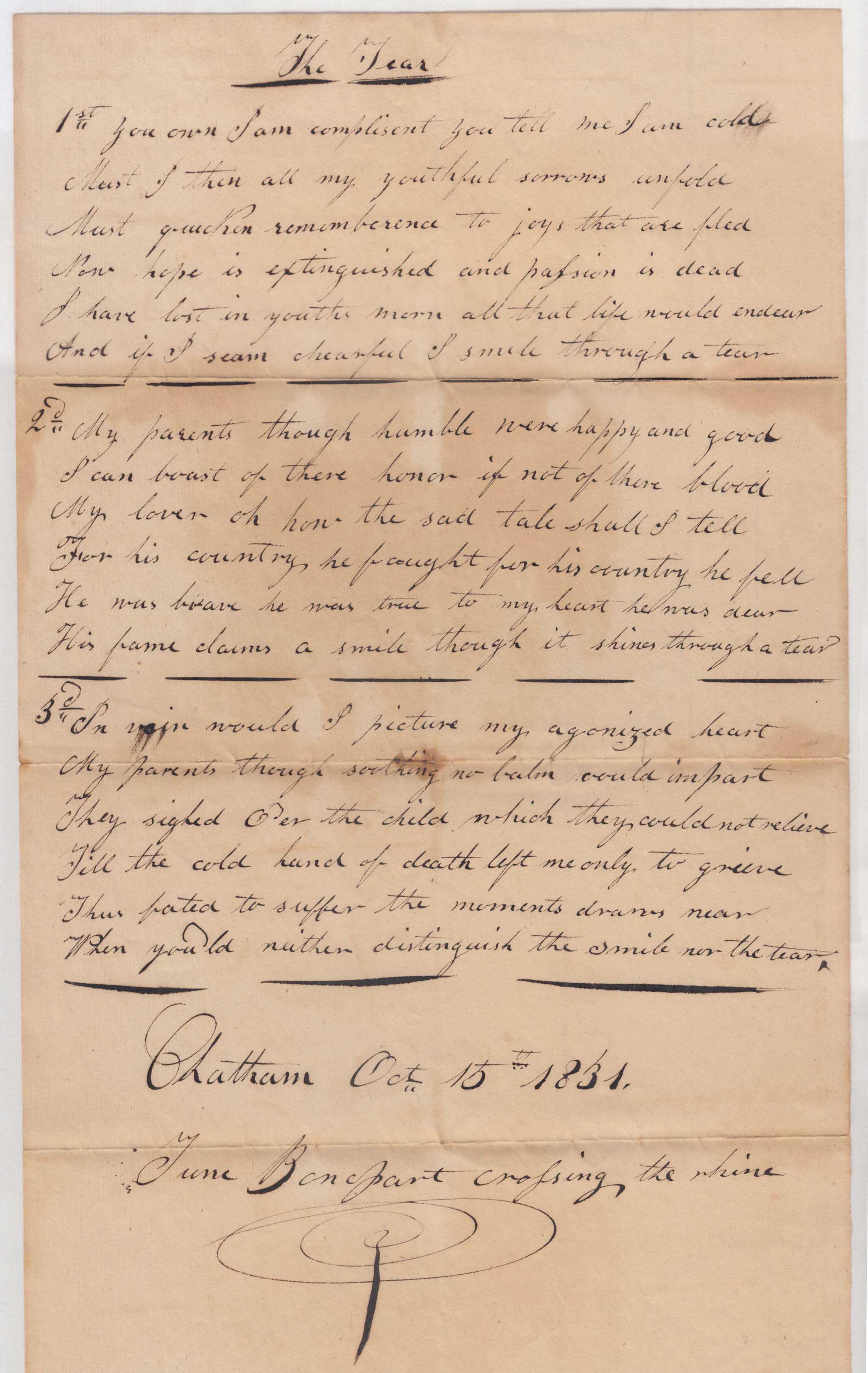
Image: HBC011.jpg
Transcription
The Tear
1st You own I am complisent{sic} you tell me I am cold Must I then all my youthful sorrows unfold Must quicken rememberence to joys that are fled Now hope is extinguished and passion is dead I have lost in youths morn all that life would endear And if I seam{sic} chearful I smile through a tear
2d My parents though humble were happy and good I can boast of there{sic} honor if not of there{sic} blood My lover oh how the sad tale shall I tell For his country he fought for his country he fell He was brave he was true to my heart he was dear His fame claims a smile though it shines through a tear
3d In vain would I picture my agonized heart My parents though soothing no balm could impart They sighed O'er the child which they could not relieve Till{sic} the cold hand of death left me only to grieve Thus fated to suffer the moments draws{sic} near When you'ld{sic} neither distinguish the smile nor the tear
Chatham Oct 15th 1831 Tune Bonepart crossing the rhine
— Transcribed by Claude.ai on 2026-05-10 - jhc
Commentary
A couple thoughts occurred to me after the following Claude research inquiry. One is that this poem might be a work of fiction, a school exercise. Another is that, because of it's being in this collection it is likely by a family member, the date putting it most likely in the Bain line. I guessed it was written by Sarah DePew Snyder, born about 28 FEB 1808, married Hugh Bain 1 MAR 1832 at about 24y. If she wrote this at 23yo it is likely not a school exercise. Also her life seems centered around Kinderhook, not Chatham, so I now think it unlikely to be her work. Perhaps it was gifted into the Bain family. jhc
On further reflection: its Chatham dateline might be an indication this poem came into the collection via early Crandell family connections (Solomon Crandell having bought his property in Chatham in 1829 and opened his store shortly after) rather than through the Bain family I conjectured above. jhc
Notes:
(Based on the assumption it was written by Sarah DePew Snyder - jhc)
- “The Tear” — a sentimental poem in three stanzas, written or copied by Sarah DePew Snyder at Chatham, October 15, 1831. Sarah was 23 years old at this date, married to Hugh Bain, Lydia and Peter’s son.
- “Tune: Bonaparte Crossing the Rhine” — a popular melody of the period, indicating this was a song lyric rather than purely a poem. “Bonaparte Crossing the Rhine” was a well-known Irish/American tune of the early 19th century, suggesting Sarah either composed these words to fit the melody or copied them from a songbook or manuscript collection.
- The narrative of the poem:
- First stanza — a woman accused of being cold, defending herself — her cheerfulness is a mask over grief, she smiles through tears
- Second stanza — she comes from humble but honorable parents; her lover died fighting for his country — a soldier fallen in war
- Third stanza — her parents tried to comfort her but couldn’t; they too died leaving her alone to grieve
- “My lover oh how the sad tale shall I tell / For his country he fought for his country he fell” — a soldier’s death, consistent with the War of 1812 period just two decades earlier, or possibly the Revolutionary War in a more historical/sentimental context.
- The emotional register — loss, grief masked by cheerfulness, parental death, isolation — consistent with the sentimental literary culture of the 1820s-1830s, when such poems were commonly copied into personal manuscript collections by young women.
- Chatham, October 15, 1831 — Sarah writing or copying this in Chatham, Columbia County, where the Bain family had connections as we saw in the farm deed referencing “the Kripple Bush” parcel in Chatham.
- Why in the archive — personal papers and literary compositions were commonly kept alongside commercial and legal documents in family archives of this period. Sarah’s poem represents the archive’s most purely personal and literary document — a young woman’s emotional expression preserved alongside deeds, receipts, and account books spanning 150 years.
- The contrast with the archive’s earliest documents is striking — from Robert Livingston executing a land deed in 1679 Dutch legalese to a young woman copying a sentimental song lyric in 1831 English — yet both preserved in the same family collection, the human thread connecting them across the generations.
From a Claude.ai Research Inquiry:
Given the date -- October 1831 -- and a Chatham, NY dateline (Columbia County), the most likely conflict being mourned would be the War of 1812, which ended in 1815. A veteran dying around 1831 would have been in his 40s or 50s at minimum, a plausible age for a War of 1812 soldier.
A few other possibilities worth considering:
- Revolutionary War -- Less likely, as survivors would have been quite elderly by 1831, though not impossible. There was considerable reverence for remaining Revolutionary veterans in that era.
- War of 1812 -- The most probable fit. The war ended only 16 years before the poem's date, so veterans would have been middle-aged and the conflict fresh in memory.
- Local militia or frontier service -- Columbia County men served in various capacities, and a local elegy might honor someone whose service was more regional.
Given that Chatham is in Columbia County -- your family's territory -- this could conceivably connect to your genealogical research. Does the poem mention the person's name, rank, or the specific conflict? That would help nail it down. A newspaper publication (the Columbia Republican or Kinderhook Gazette were active in that area) might also help date and attribute it.
No names though it seems written by a teenaged girl and comes down in a Kinderhook family. - jhc
That's a lovely piece of social history. A few thoughts:
- The War of 1812 connection is even stronger given the Kinderhook provenance. Columbia County sent significant numbers of men to that war, and by 1831 a teenage girl writing an elegy could well be mourning a father, uncle, or older brother who survived the war but died of lingering wounds, illness, or simply in his prime years afterward -- a common enough story.
- The Kinderhook angle is intriguing because the town's most famous son, Martin Van Buren, was deeply involved in New York politics and had strong connections to the War of 1812 era politically, though that may be coincidental.
- A teenage girl writing memorial verse in 1831 fits perfectly with the period's culture -- sentimental poetry was considered an accomplishment for young women, and mourning verse especially was a recognized feminine genre. It was commonly written in albums, copybooks, or on black-bordered mourning paper.
- The Revolutionary War possibility shouldn't be entirely dismissed -- in 1831 a teenage girl could have had a grandfather who served, and the cult of Revolutionary memory was intensifying in that period as the last survivors were dying off.
Do you have a sense of the relationship -- does the poem's language suggest she's mourning a family member, or is it more of a community tribute to a local figure?
She seems to be referring to her fallen lover. - jhc
That shifts things considerably -- and makes it more poignant. A teenage girl mourning a fallen lover in 1831 Kinderhook points in an interesting direction:
- The timeline becomes tighter. If he was her lover rather than an elderly relative, he was likely young -- which pushes away from the Revolution almost entirely and firmly toward the War of 1812. A man who served at 16--18 in 1812--1815 would be in his early-to-mid 30s by 1831, a plausible age for a young woman's romantic interest.
- "Fallen" is worth examining closely. Does the poem suggest he died in the conflict, or that he died later -- perhaps of wounds, illness, or hardship traceable to his service? Many War of 1812 veterans died years afterward of service-related causes, and elegies of the period often honored that connection explicitly.
- The Kinderhook family context raises the question of whether this was a private keepsake -- written in a commonplace book or album -- or something more formally composed, perhaps even intended for a local paper. Mourning poetry by young women sometimes circulated in manuscript among family and friends without ever being published.
Is the poem in manuscript? And do you have a sense of its length and form -- a standard elegiac meter, or something more personal and irregular? Those details might help identify whether she was working from a model or writing from the heart.
It is on one sheet and references "Tune Bonepart Crossing the Rhine" at the bottom. - jhc
That's a wonderful detail -- it transforms the poem significantly. "Bonaparte Crossing the Rhine" is a song tune indication, meaning the poem was written to be sung, not merely read. This was completely standard practice in the early 19th century -- poems were routinely written "to the tune of" a well-known air, much like broadside ballads.
Bonaparte Crossing the Rhine was a popular American and British folk melody of the period, with a distinctive martial, mournful character -- entirely appropriate for a war elegy. It circulated widely in the early republic and appears in numerous songbooks and on broadsides of the 1810s--1830s.
This detail actually strengthens the War of 1812 connection considerably. That tune was particularly associated with the Napoleonic era and its American echoes, and it was in wide circulation precisely during and after the War of 1812. Choosing it for a martial elegy in 1831 would have been a natural, even conventional choice.
The single-sheet format suggests this may have been composed as a kind of personal broadside or keepsake -- possibly fair-copied after composition, perhaps to share with family. The fact that it names the tune suggests she intended it to be performed, not just read.
Do you know if the sheet appears to be a clean fair copy in a careful hand, or does it look more like a working draft? And is the handwriting consistent with a young woman's schooled script of the period?
It is in 3 stanzas in a not entirely schooled script. There is a couple smudges and it is fairly carefully laid out. - jhc
That physical description paints a very clear picture. A few observations:
- Not entirely schooled script with smudges but careful layout suggests this is almost certainly the original composition draft -- or possibly a second copy made shortly after -- rather than a later transcription. A truly finished fair copy for circulation would typically show more practiced penmanship. The smudges suggest she was working carefully but was not a highly trained penman -- consistent with a rural Columbia County girl of modest but literate means in 1831.
- Three stanzas is a very natural elegiac structure for the period -- typically a stanza establishing the loss, one honoring the service or virtue of the deceased, and a closing one expressing grief or hope of reunion. Does that rough progression match what you're reading?
- The tune reference at the bottom rather than the top is slightly unusual -- more often the tune was noted at the head of the poem. Placing it at the bottom might suggest she added it as an afterthought, or that it was a personal notation rather than a heading meant for a reader.
This sounds like a genuinely touching and historically interesting document -- a primary source artifact of early American mourning culture from a specific place and moment. Given the Kinderhook family provenance, Columbia County Historical Society would likely find it significant.
The refrain structure -- each stanza ending with a variation on "smile through a tear" -- is sophisticated. And "he fell" in stanza two is unambiguous: he died in battle. A genuinely moving piece.
— Notes by Claude.ai 4.6 2026-05-10 - jhc
Metadata
Document: HBC011
Date: 1831-10-15
Language: English
Type: Poem
Subject: Entertainment
Principals: Unknown
Places Mentioned: Chatham
— page revised 2026-05-19 - jhc
< Next Earlier Document — Next Later Document >
Huyck Bain Crandell Collection © 2026 by John H. Coxon is licensed under CC BY-NC-SA 4.0


