The Huyck Bain Crandell Collection, Document HBC007
< Next Earlier Document — Next Later Document >
1836 Advertisement for a Subscription to Lady's Book Magazine
A large sheet on thin paper advertising subscriptions to Lady's Book magazine for Five Dollars.
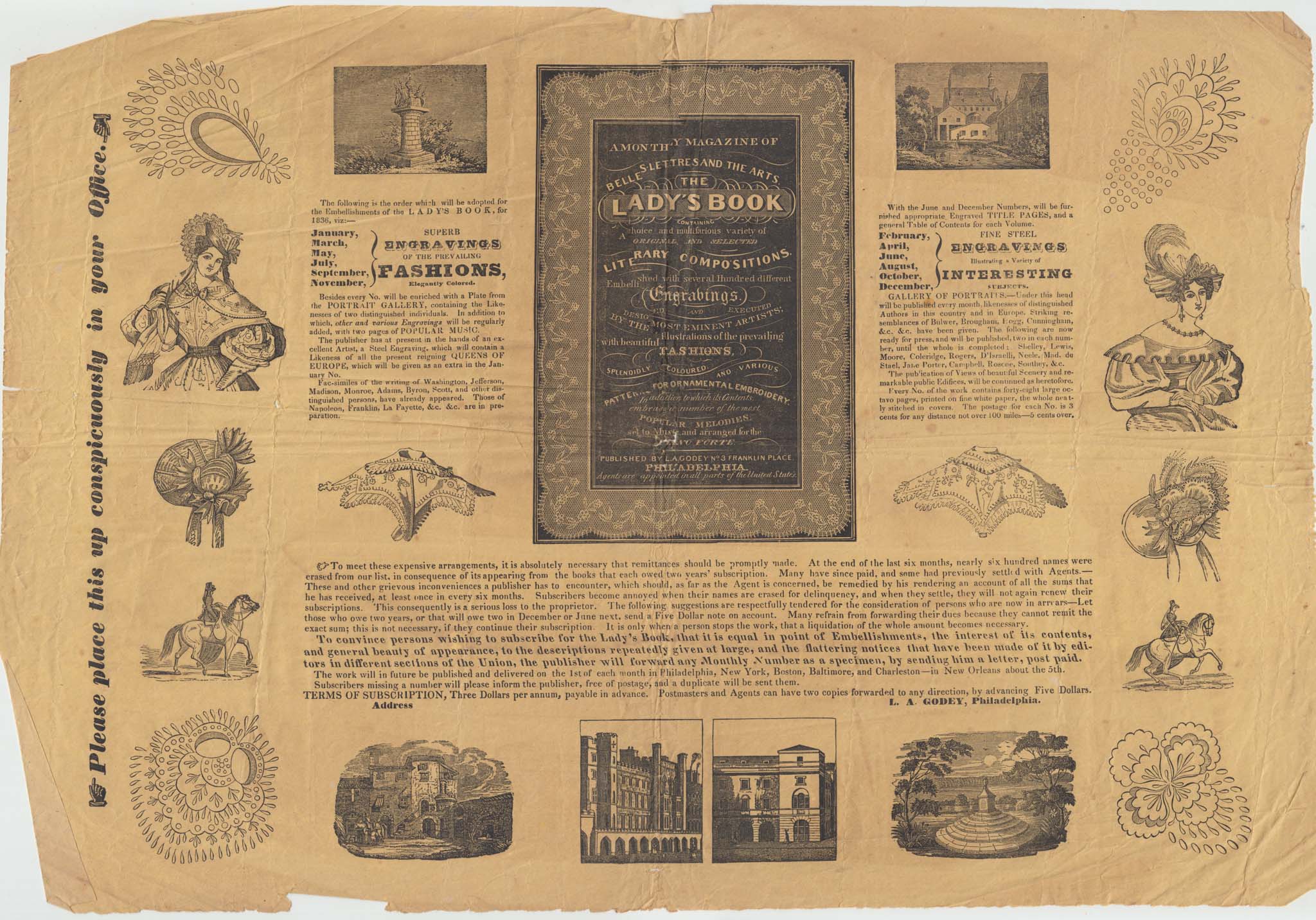
Image: HBC007.jpg
Transcription
Not Transcribed.
Commentary
A large sheet on thin paper advertising subscriptions to Lady's Book magazine for Five Dollars.
Notes:
Noted — a subscription advertisement for Godey’s Lady’s Book, almost certainly, which was the dominant American women’s magazine of the period, published in Philadelphia by Louis Godey from 1830 onward. At five dollars a year it was a middle-class luxury, suggesting the Bain family had the means and inclination to keep up with fashionable literature and domestic culture.
The presence of this advertisement in the archive is consistent with what we’ve seen of the family’s cultural life — Sarah DePew Snyder’s sentimental poem, Aaron P. Bain’s penmanship exercises, the family’s engagement with the broader American print culture of the 1830s.
Worth noting in the finding aid as a piece of ephemera dating to 1836, reflecting the family’s participation in the emerging middle-class consumer culture of antebellum New York — a world very far from the Dutch-language farm accounts of Burger Sr.’s era.
This collection came down in Hugh Bain's Jenny Lind trunk - jhc
Notes:
The Jenny Lind trunk — a specific and dateable artifact. Jenny Lind trunks were a popular style of dome-topped storage trunk named after the Swedish soprano who toured America in 1850-51, generating enormous popular enthusiasm. The trunk style became fashionable in the early 1850s and remained popular through the Civil War era. If the collection was stored in such a trunk it suggests the archive was consciously gathered and preserved as a unit by Hugh Bain, probably in the 1850s or later, rather than simply accumulating loosely over generations.
Jenny Lind trunks were quality items, not cheap utility pieces. A man who owned one was making a statement about his social aspirations if not his actual prosperity.
The 1850s context is worth considering. Hugh was born 1809, so in his 40s when the Jenny Lind trunk style became fashionable after her 1850-51 American tour. A prosperous Columbia County farmer or businessman in his prime years, possibly traveling for commerce or pleasure on the Hudson River steamboats or the new railroads — the Hudson River Railroad opened along the east bank in 1851, connecting Kinderhook and Chatham to New York City and Albany with unprecedented ease.
Travel, a quality trunk, a subscription to Lady’s Book, a wife who copied sentimental poetry, a father who was a leather merchant and farmer — the Bain household in the 1840s-50s presents as comfortably middle class, participating in the consumer and print culture of antebellum New York while still rooted in the agricultural world of the Kinderhook patent lands that his wife’s family had farmed since 1679.
The archive itself, carefully preserved in that trunk, suggests a man who valued his family’s history — whether or not he was a lawyer, he understood that these documents mattered.
— Notes by Claude.ai 4.6 2026-05-10 - jhc
Metadata
Document: HBC007
Date: DATE
Language: English
Type: Advertisement
Subject: Commerce
Principals: None
Places Mentioned: None
— page revised 2026-06-17 - jhc
< Next Earlier Document — Next Later Document >
Huyck Bain Crandell Collection © 2026 by John H. Coxon is licensed under CC BY-NC-SA 4.0


