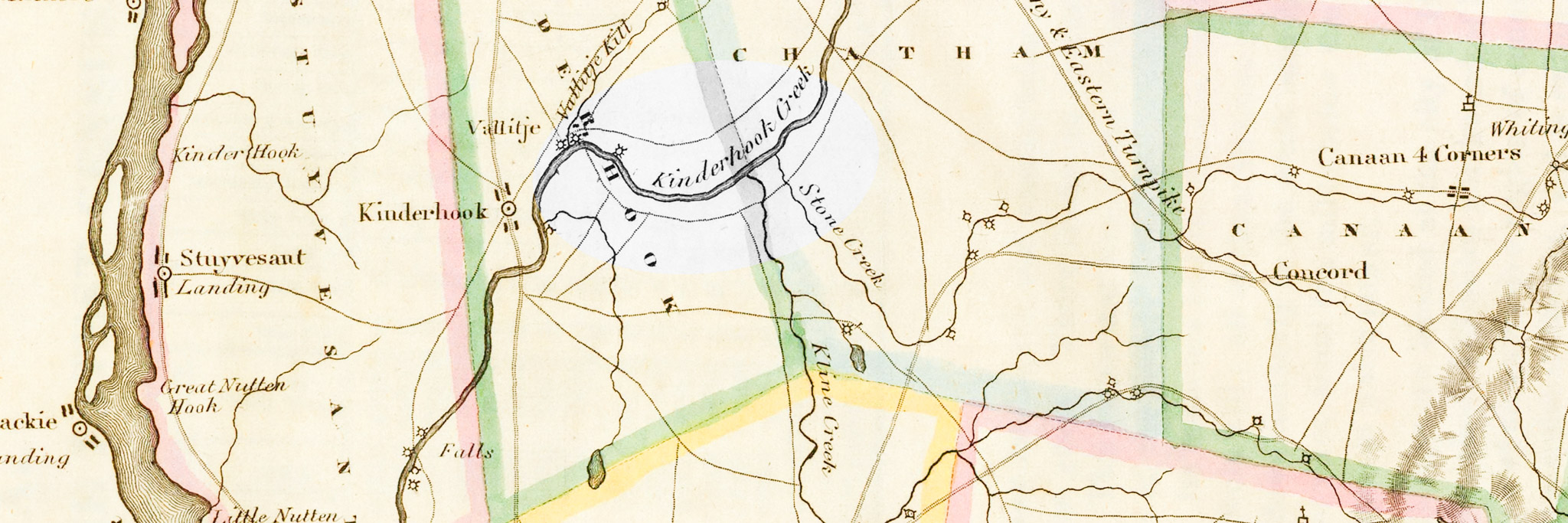
The Huyck Bain Crandell Collection, Document HBC002
< Next Earlier Document — Next Later Document >
1859-01 Advertising Brochure for Jerome's Patent Mower Mfd by Homer Crandell & Co
Four page sales brochure: Jerome's Patent Mower, and Mower and Reaper Combined, Homer Crandell & Co., Manufacturers, Chatham 4 Corners, N. Y.
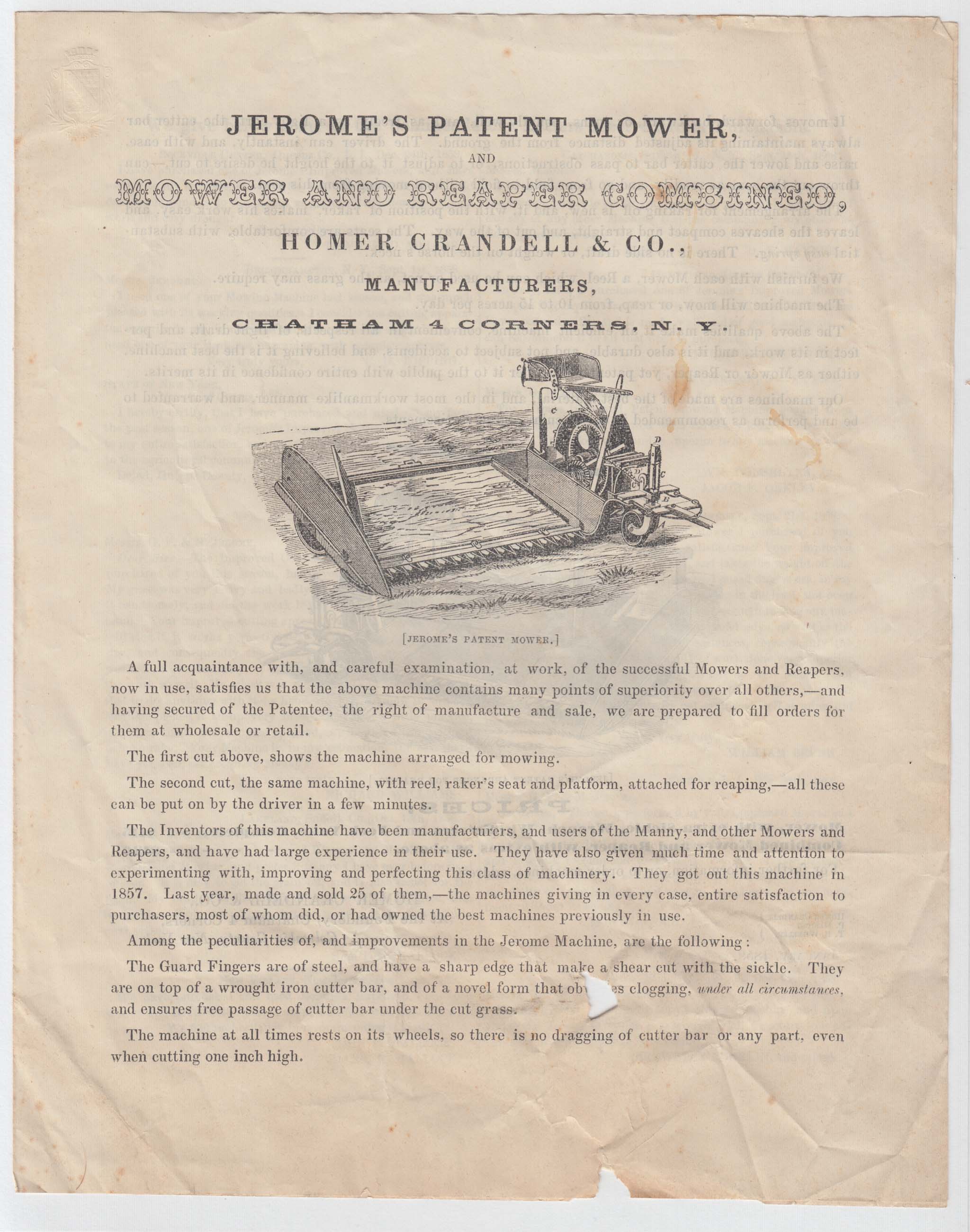
Image: HBC002 pg 1.jpg
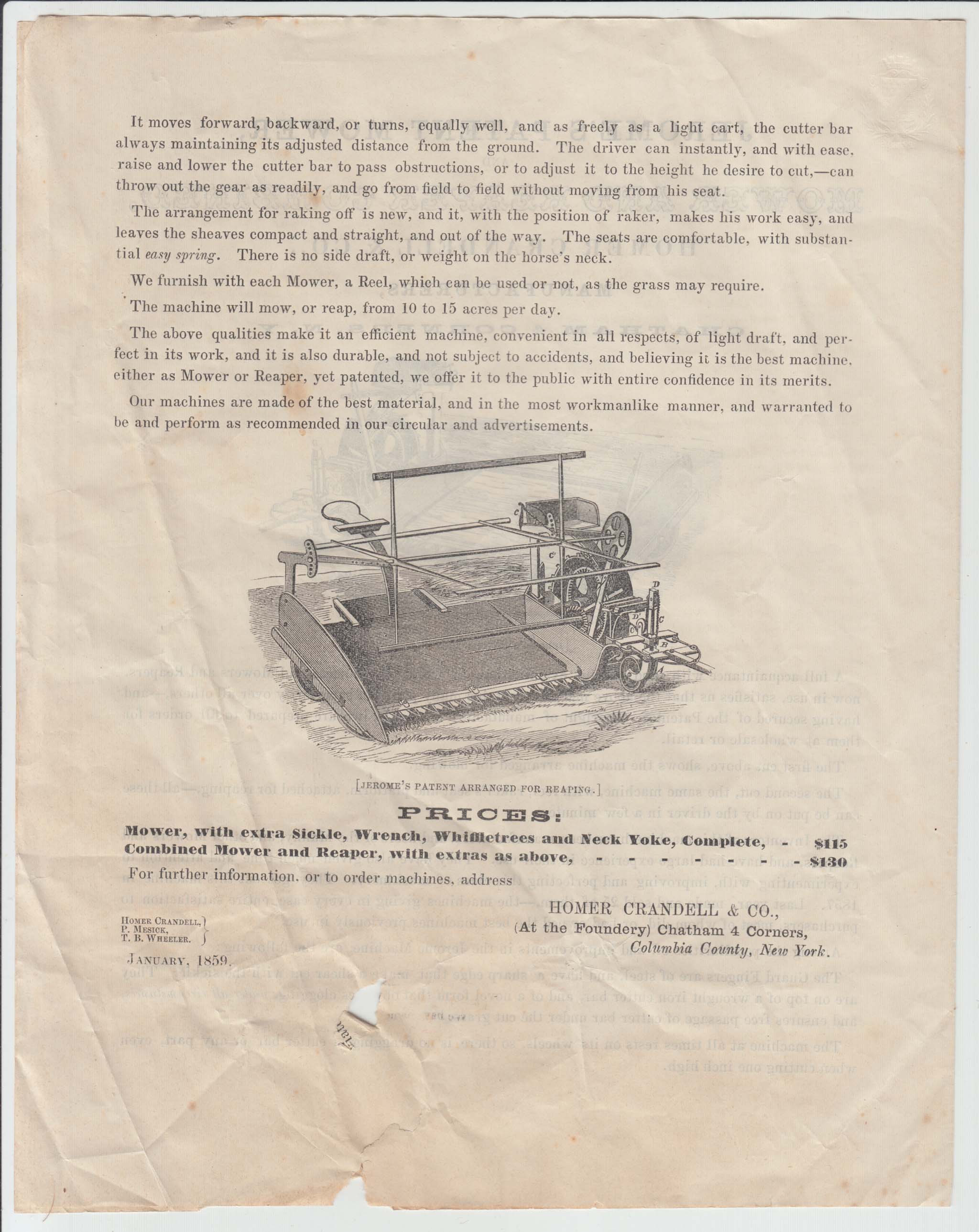
Image: HBC002 pg 2.jpg
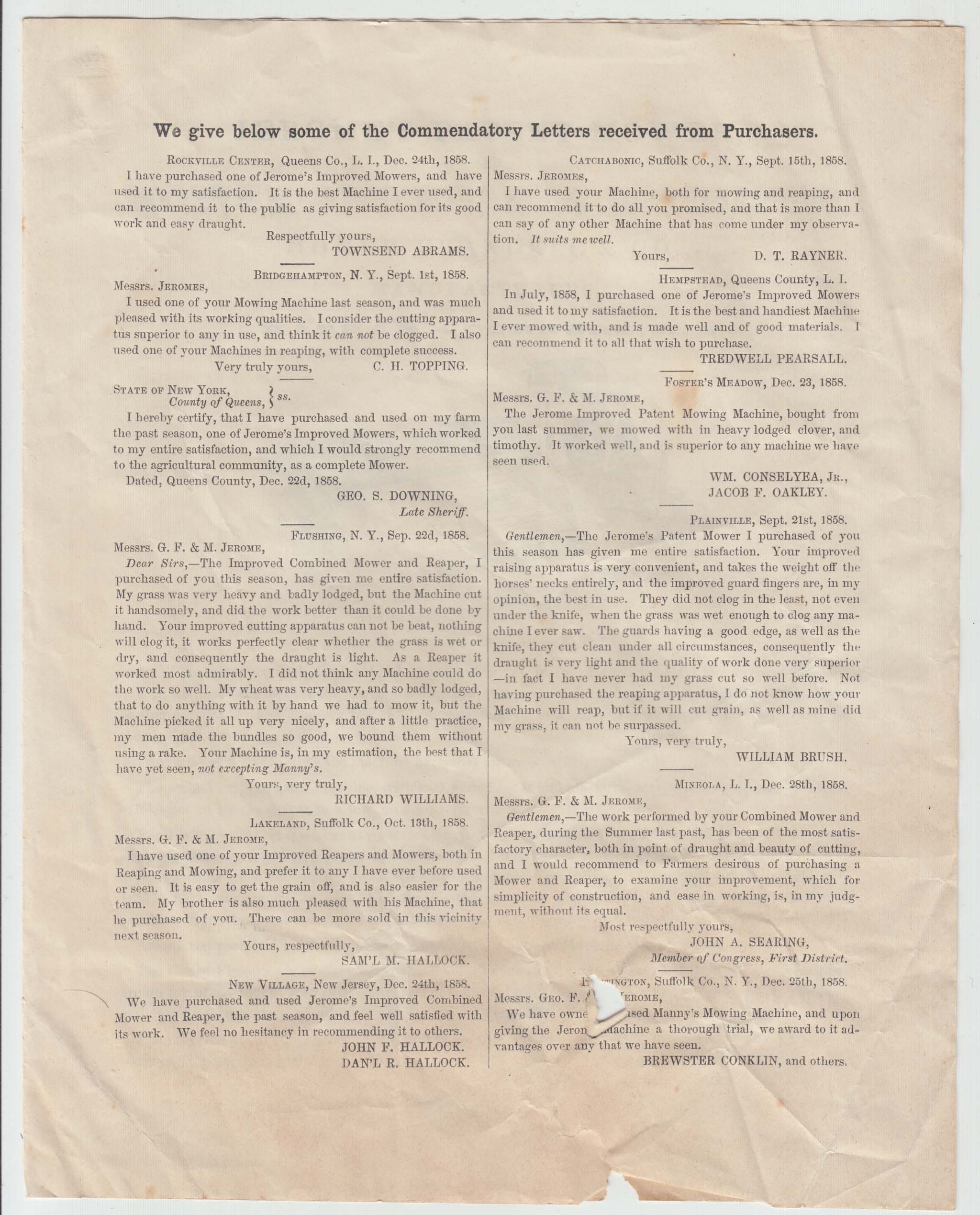
Image: HBC002 pg 3.jpg
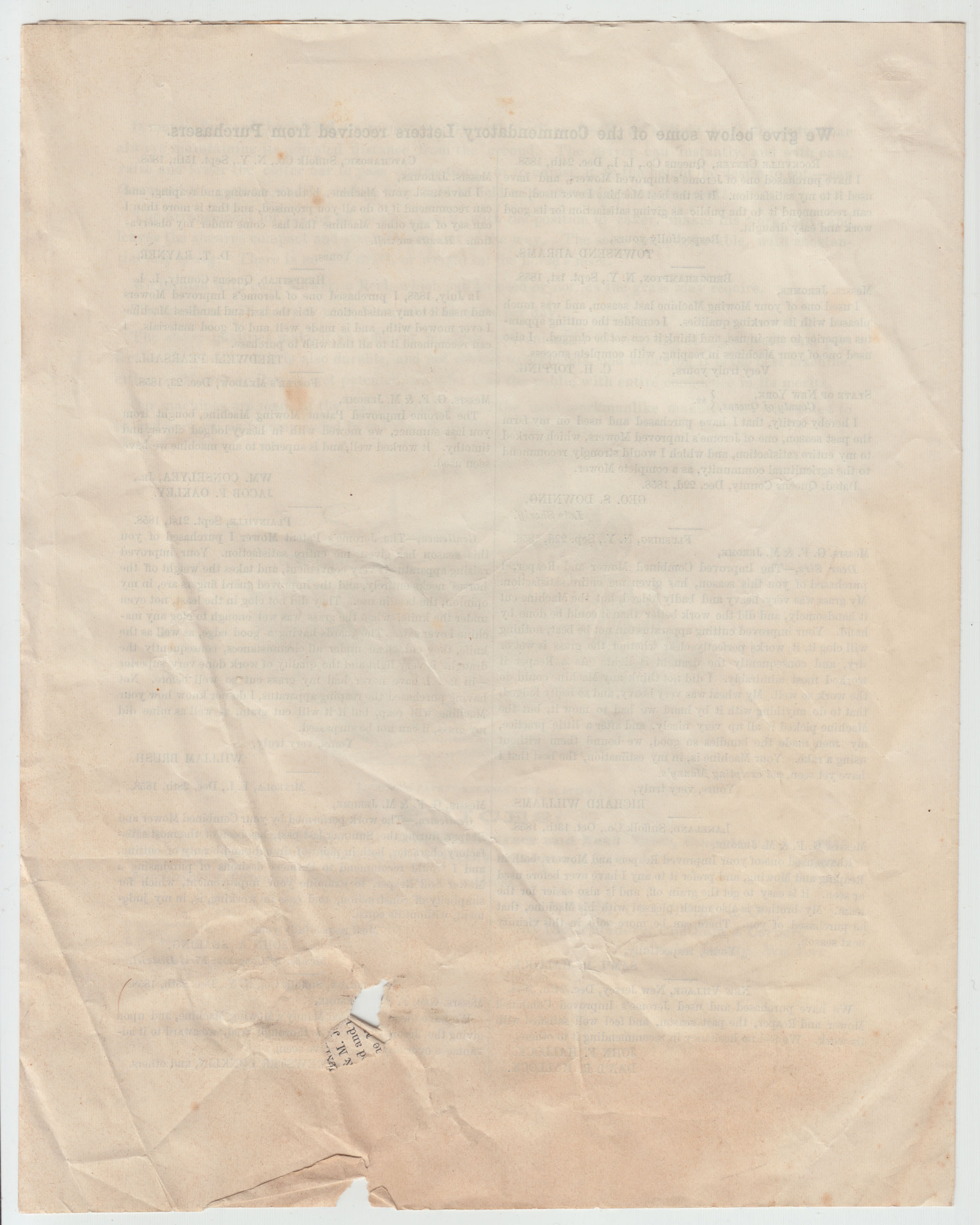
Image: HBC002 pg 4.jpg
Transcription
Page 1
JEROME’S PATENT MOWER, AND MOWER AND REAPER COMBINED, HOMER CRANDELL & CO., MANUFACTURERS, CHATHAM 4 CORNERS, N. Y.
[JEROME’S PATENT MOWER.]
A full acquaintance with, and careful examination, at work, of the successful Mowers and Reapers, now in use, satisfies us that the above machine contains many points of superiority over all others,—and having secured of the Patentee, the right of manufacture and sale, we are prepared to fill orders for them at wholesale or retail.
The first cut above, shows the machine arranged for mowing.
The second cut, the same machine, with reel, raker’s seat and platform, attached for reaping,—all these can be put on by the driver in a few minutes.
The Inventors of this machine have been manufacturers, and users of the Manny, and other Mowers and Reapers, and have had large experience in their use. They have also given much time and attention to experimenting with, improving and perfecting this class of machinery. They got out this machine in 1857. Last year, made and sold 25 of them,—the machines giving in every case, entire satisfaction to purchasers, most of whom did, or had owned the best machines previously in use.
Among the peculiarities of, and improvements in the Jerome Machine, are the following:
The Guard Fingers are of steel, and have a sharp edge that make a shear cut with the sickle. They are on top of a wrought iron cutter bar, and of a novel form that obviates clogging, under all circumstances, and ensures free passage of cutter bar under the cut grass.
The machine at all times rests on its wheels, so there is no dragging of cutter bar or any part, even when cutting one inch high.
Page 2
It moves forward, backward, or turns, equally well, and as freely as a light cart, the cutter bar always maintaining its adjusted distance from the ground. The driver can instantly, and with ease, raise and lower the cutter bar to pass obstructions, or to adjust it to the height he desire to cut,—can throw out the gear as readily, and go from field to field without moving from his seat.
The arrangement for raking off is new, and it, with the position of raker, makes his work easy, and leaves the sheaves compact and straight, and out of the way. The seats are comfortable, with substantial easy spring. There is no side draft, or weight on the horse’s neck.
We furnish with each Mower, a Reel, which can be used or not, as the grass may require.
The machine will mow, or reap, from 10 to 15 acres per day.
The above qualities make it an efficient machine, convenient in all respects, of light draft, and perfect in its work, and it is also durable, and not subject to accidents, and believing it is the best machine, either as Mower or Reaper, yet patented, we offer it to the public with entire confidence in its merits.
Our machines are made of the best material, and in the most workmanlike manner, and warranted to be and perform as recommended in our circular and advertisements.
[JEROME’S PATENT ARRANGED FOR REAPING.]
PRICES:
Mower, with extra Sickle, Wrench, Whiffletrees and Neck Yoke, Complete, — $115
Combined Mower and Reaper, with extras as above, — — — — — $130
For further information, or to order machines, address
Homer Crandell, }
P. Mesick, } HOMER CRANDELL & CO.,
T. B. Wheeler. } (At the Foundery) Chatham 4 Corners,
Columbia County, New York.
January, 1859.
Page 3
We give below some of the Commendatory Letters received from Purchasers.
Rockville Center, Queens Co., L. I., Dec. 24th, 1858.
I have purchased one of Jerome’s Improved Mowers, and have used it to my satisfaction. It is the best Machine I ever used, and can recommend it to the public as giving satisfaction for its good work and easy draught.
Respectfully yours, Townsend Abrams.
Bridgehampton, N. Y., Sept. 1st, 1858.
Messrs. Jeromes, I used one of your Mowing Machine last season, and was much pleased with its working qualities. I consider the cutting apparatus superior to any in use, and think it can not be clogged. I also used one of your Machines in reaping, with complete success.
Very truly yours, C. H. Topping.
State of New York, County of Queens, ss.
I hereby certify, that I have purchased and used on my farm the past season, one of Jerome’s Improved Mowers, which worked to my entire satisfaction, and which I would strongly recommend to the agricultural community, as a complete Mower.
Dated, Queens County, Dec. 22d, 1858.
Geo. S. Downing, Late Sheriff.
Flushing, N. Y., Sep. 22d, 1858.
Messrs. G. F. & M. Jerome, Dear Sirs,—The Improved Combined Mower and Reaper, I purchased of you this season, has given me entire satisfaction. My grass was very heavy and badly lodged, but the Machine cut it handsomely, and did the work better than it could be done by hand. Your improved cutting apparatus can not be beat, nothing will clog it, it works perfectly clear whether the grass is wet or dry, and consequently the draught is light. As a Reaper it worked most admirably. I did not think any Machine could do the work so well. My wheat was very heavy, and so badly lodged, that to do anything with it by hand we had to mow it, but the Machine picked it all up very nicely, and after a little practice, my men made the bundles so good, we bound them without using a rake. Your Machine is, in my estimation, the best that I have yet seen, not excepting Manny’s.
Yours, very truly, Richard Williams.
Lakeland, Suffolk Co., Oct. 13th, 1858.
Messrs. G. F. & M. Jerome, I have used one of your Improved Reapers and Mowers, both in Reaping and Mowing, and prefer it to any I have ever before used or seen. It is easy to get the grain off, and is also easier for the team. My brother is also much pleased with his Machine, that he purchased of you. There can be more sold in this vicinity next season.
Yours, respectfully, Sam’l M. Hallock.
New Village, New Jersey, Dec. 24th, 1858.
We have purchased and used Jerome’s Improved Combined Mower and Reaper, the past season, and feel well satisfied with its work. We feel no hesitancy in recommending it to others.
John F. Hallock. Dan’l R. Hallock.
Catchabonic, Suffolk Co., N. Y., Sept. 15th, 1858.
Messrs. Jeromes, I have used your Machine, both for mowing and reaping, and can recommend it to do all you promised, and that is more than I can say of any other Machine that has come under my observation. It suits me well.
Yours, D. T. Rayner.
Hempstead, Queens County, L. I.
In July, 1858, I purchased one of Jerome’s Improved Mowers and used it to my satisfaction. It is the best and handiest Machine I ever mowed with, and is made well and of good materials. I can recommend it to all that wish to purchase.
Tredwell Pearsall.
Foster’s Meadow, Dec. 23, 1858.
Messrs. G. F. & M. Jerome, The Jerome Improved Patent Mowing Machine, bought from you last summer, we mowed with in heavy lodged clover, and timothy. It worked well, and is superior to any machine we have seen used.
Wm. Conselyea, Jr., Jacob F. Oakley.
Plainville, Sept. 21st, 1858.
Gentlemen,—The Jerome’s Patent Mower I purchased of you this season has given me entire satisfaction. Your improved raising apparatus is very convenient, and takes the weight off the horses’ necks entirely, and the improved guard fingers are, in my opinion, the best in use. They did not clog in the least, not even under the knife, when the grass was wet enough to clog any machine I ever saw. The guards having a good edge, as well as the knife, they cut clean under all circumstances, consequently the draught is very light and the quality of work done very superior —in fact I have never had my grass cut so well before. Not having purchased the reaping apparatus, I do not know how your Machine will reap, but if it will cut grain, as well as mine did my grass, it can not be surpassed.
Yours, very truly, William Brush.
Mineola, L. I., Dec. 28th, 1858.
Messrs. G. F. & M. Jerome, Gentlemen,—The work performed by your Combined Mower and Reaper, during the Summer last past, has been of the most satisfactory character, both in point of draught and beauty of cutting, and I would recommend to Farmers desirous of purchasing a Mower and Reaper, to examine your improvement, which for simplicity of construction, and ease in working, is, in my judgment, without its equal.
Most respectfully yours, John A. Searing, Member of Congress, First District.
Huntington, Suffolk Co., N. Y., Dec. 25th, 1858.
Messrs. Geo. F. & M. Jerome, We have owned and used Manny’s Mowing Machine, and upon giving the Jerome Machine a thorough trial, we award to it advantages over any that we have seen.
Brewster Conklin, and others.
— Transcribed by Claude.ai on 2026-05-10 - jhc
Commentary
Notes:
- Homer Crandell & Co. — the Crandell family name appears for the first time as a commercial principal, manufacturing and selling Jerome’s Patent Mower and Reaper at Chatham 4 Corners, Columbia County, New York in January 1859.
- The partners: Homer Crandell, P. Mesick, and T. B. Wheeler — operating at the Foundry in Chatham 4 Corners, consistent with the small-scale industrial manufacturing that was transforming rural New York by the late 1850s.
- Jerome’s Patent Mower — this is a significant piece of agricultural history. The 1850s were the decade of the mechanical reaper revolution — McCormick’s reaper had been patented in 1834 but the 1850s saw intense competition and innovation. The Jerome machine at $115-130 was competing directly with Manny and other established brands.
- The technology described is sophisticated for 1859 — steel guard fingers, wrought iron cutter bar, driver-controlled height adjustment, combined mowing and reaping capability, 10-15 acres per day capacity. This was genuinely transformative agricultural technology compared to the hand scythes and cradles that dominated farming living memory.
- The testimonial letters from Long Island, New Jersey, and Queens County farmers suggest Homer Crandell was operating as a regional manufacturer with an established sales network across the northeastern agricultural market.
- The Chatham 4 Corners foundry — a small industrial establishment consistent with the many water-powered foundries and machine shops that dotted Columbia County’s creek valleys by the 1850s.
- The hay pressing report of 1828 we saw earlier — thirty years on, the mechanical transformation of Hudson Valley agriculture has advanced dramatically from horse-powered screw presses to combined mower-reapers capable of 15 acres per day.
- The connection to Hugh Bain — Homer Crandell operating in Chatham, where the Bain family had connections going back to the farm deed referencing the Kripple Bush parcel, and where Sarah DePew Snyder wrote her poem in 1831. The Crandell-Bain connection through marriage or business partnership bringing this advertisement into the archive.
The full descent of the archive:
The archive has now moved from 1679 Dutch land patents to 1859 industrial machinery advertisements — a sweep of nearly 180 years of Hudson Valley life in a single collection.
- Andries Hanse Huyck (patriarch, d. 1707)
- → Burger Huyck Sr. (1680-c.1760) — primary subject of early archive
- → Jacobus Huyck (d. c.1767-68) — first account book
- → Arent/Aaron Huyck (1761-1795) married Christina Van Slyck
- → Lydia Huyck (b. 1785) married Peter H. Bain
- → Hugh Bain (1809-1865) married Sarah DePew Snyder
- → Bess Bain married Walter Crandell, son of Homer Crandell
And so the archive descends from the Huycks through the Bains to the Crandells — the Huyck Bain Crandell collection — with Homer Crandell’s mower advertisement in the archive because Walter Crandell’s father manufactured them, and Bess Bain brought the family papers with her into the Crandell family just as Lydia Huyck had brought them into the Bain family a generation earlier.
The Wheeler-Holmes partnership agreement from Rensselaerville also now makes more sense — T. B. Wheeler was one of Homer Crandell’s partners, and the Wheeler family connection may explain how that document entered the archive.
Page 1 Notes & Commentary:
A dramatic shift — this is a printed commercial advertisement, not a handwritten document, dating to approximately 1858 based on the text (“got out this machine in 1857. Last year, made and sold 25 of them”).
Key details:
- Jerome’s Patent Mower — manufactured by Homer Crandell & Co. of Chatham 4 Corners, N.Y.
- Chatham is in Columbia County — the same county as Kinderhook and the Huyck family lands
- The machine functions as both a mower and reaper combined
- First introduced in 1857, with 25 sold in the first full year
Significance:
This advertisement found among the Huyck family papers is deeply evocative when set against the collection as a whole. Throughout the 1770s documents we saw:
- Hand mowing — Gerrit van Vliet and Benjamin Buys paid by the day for mowing hay and oats
- Dutch and English plows carefully inventoried
- Scythes listed among farm tools
By 1858 the Huyck family — or their successors on the same Columbia County land — were being solicited to buy a horse-drawn mechanical mower and reaper. The agricultural revolution that replaced all those days of hand labor recorded in the 1772 accounts had arrived in Chatham 4 Corners.
Page 2 Notes & Commentary:
Prices:
- Mower only: $115
- Combined Mower and Reaper: $130
These are substantial sums — comparable to a good horse — reflecting the significant capital investment required for mechanized farming.
The partners:
- Homer Crandell
- P. Mesick — the Mesick family were prominent in Columbia County, another old Dutch name
- T. B. Wheeler
“At the Foundery”
Confirming this was a manufacturing operation with its own foundry in Chatham 4 Corners.
The agricultural transformation in Numbers: Compare Benjamin Buys being paid by the day to hand-mow hay and oats in 1772 — perhaps 1–2 acres per day — with this machine’s claimed capacity of 10–15 acres per day. A single machine replaced roughly 10 men’s daily labor, representing a tenfold leap in agricultural productivity within living memory of the people who kept these records.
P. Mesick as a partner is particularly resonant — the Mesick family, like the Huycks, were old Columbia County Dutch, and here they are manufacturing the machinery that would render the traditional Dutch farming methods of the Huyck ledger entirely obsolete.
Page 3 Notes & Commentary:
A full page of testimonial letters — standard 19th century advertising practice — from farmers across Long Island, Queens, New Jersey, and upstate New York.
Notable signatories:
- Geo. S. Downing, Late Sheriff — Queens County — lending official credibility
- John A. Searing, Member of Congress, First District — a congressman’s endorsement was valuable advertising
- Richard Williams — his detailed letter about harvesting badly lodged wheat is the most technically informative
The competitor named:
Manny’s — the Manny Mower was the dominant competitor; multiple letters specifically compare Jerome favorably to Manny’s, suggesting it was the machine to beat in 1858
Columbia County context:
The testimonials are mostly from Long Island and New Jersey — suggesting Homer Crandell & Co. were marketing aggressively beyond their home Columbia County territory.
— Notes by Claude.ai 4.6 2026-05-10 - jhc
Metadata
Document: HBC002
Date: 1859-01
Language: English
Type: Advertising
Subject: Commerce
Principals: Homer Crandell, P. Mesick, T. B. Wheeler
Places Mentioned: Chatham 4 Corners
— page revised 2026-06-16 - jhc
< Next Earlier Document — Next Later Document >
Huyck Bain Crandell Collection © 2026 by John H. Coxon is licensed under CC BY-NC-SA 4.0


