The Huyck Bain Crandell Collection, Document HBC009
< Next Earlier Document — Next Later Document >
1875-06-02 Handbill, Jubilee Concerts at Cady's Hall
The Wilmington Singers — a troupe of Black singers from Wilmington, North Carolina, performing spirituals and plantation songs in the post-Civil War “Jubilee Singer” tradition pioneered by the Fisk Jubilee Singers from 1871 onward. The explicit comparison to the Fisk Singers — “fully equal to the Fisk Jubilee Singers” — places this in the mid-to-late 1870s when such troupes were at the height of their popularity.
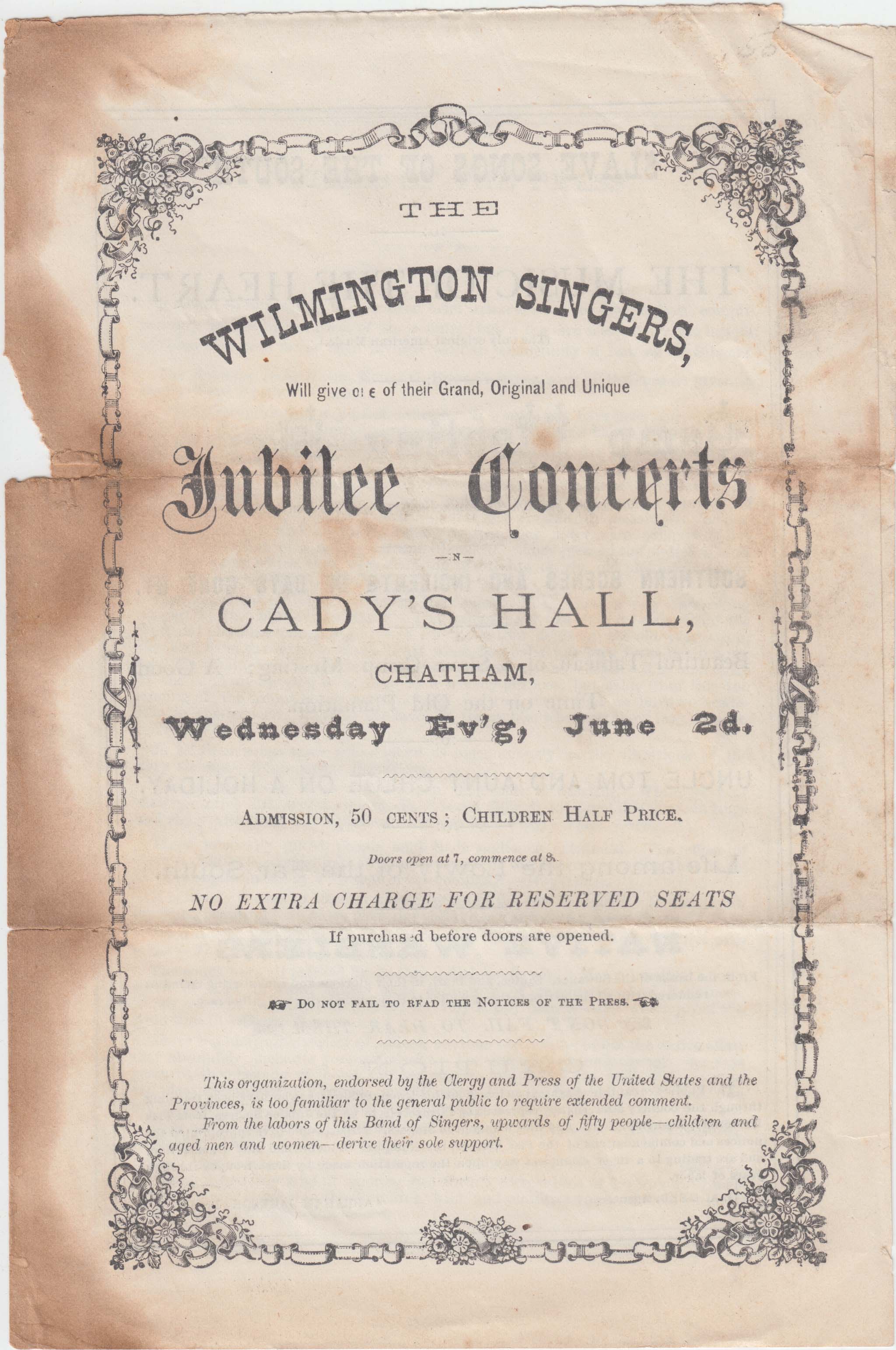
Image: HBC009 pg 1.jpg
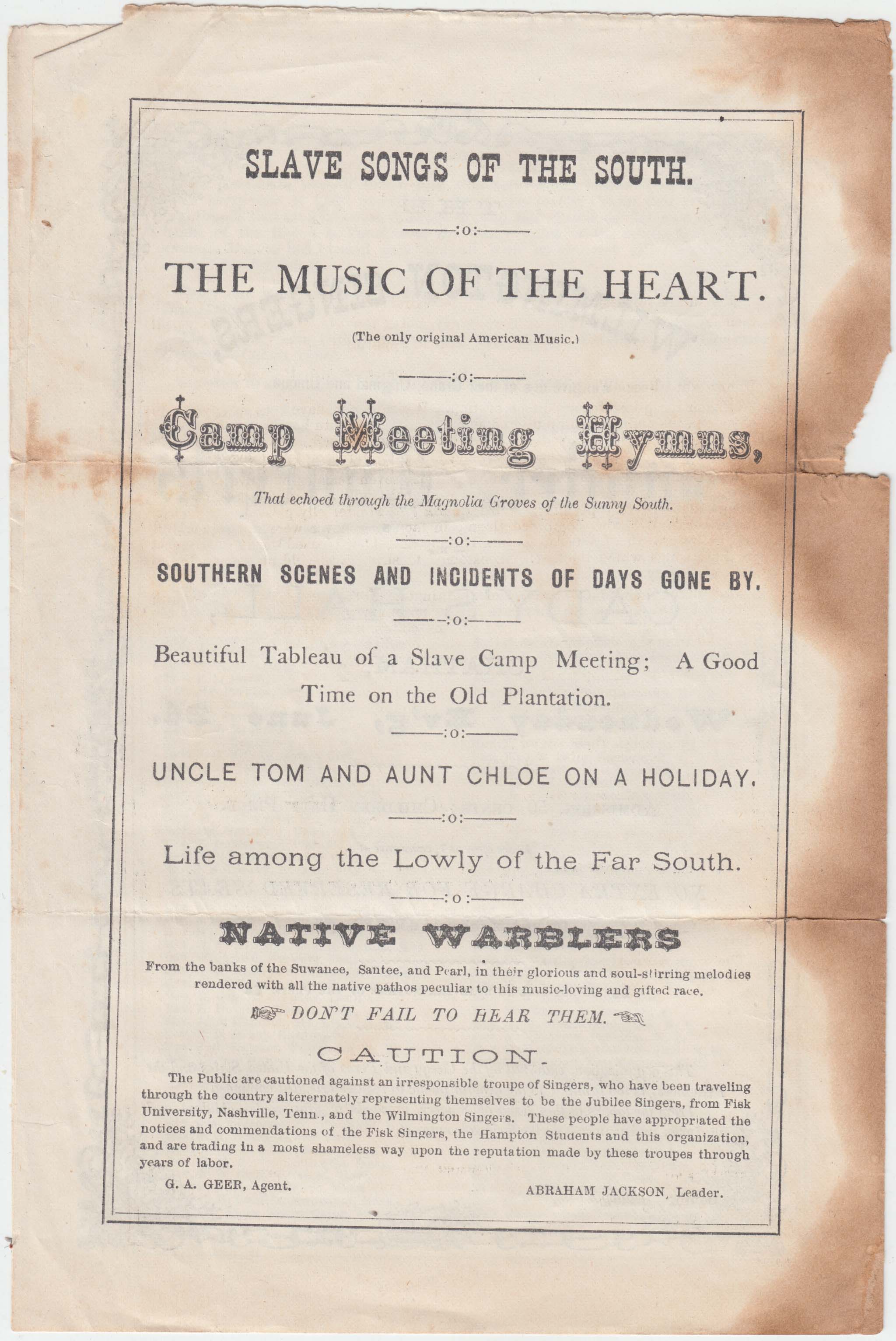
Image: HBC009 pg 2.jpg
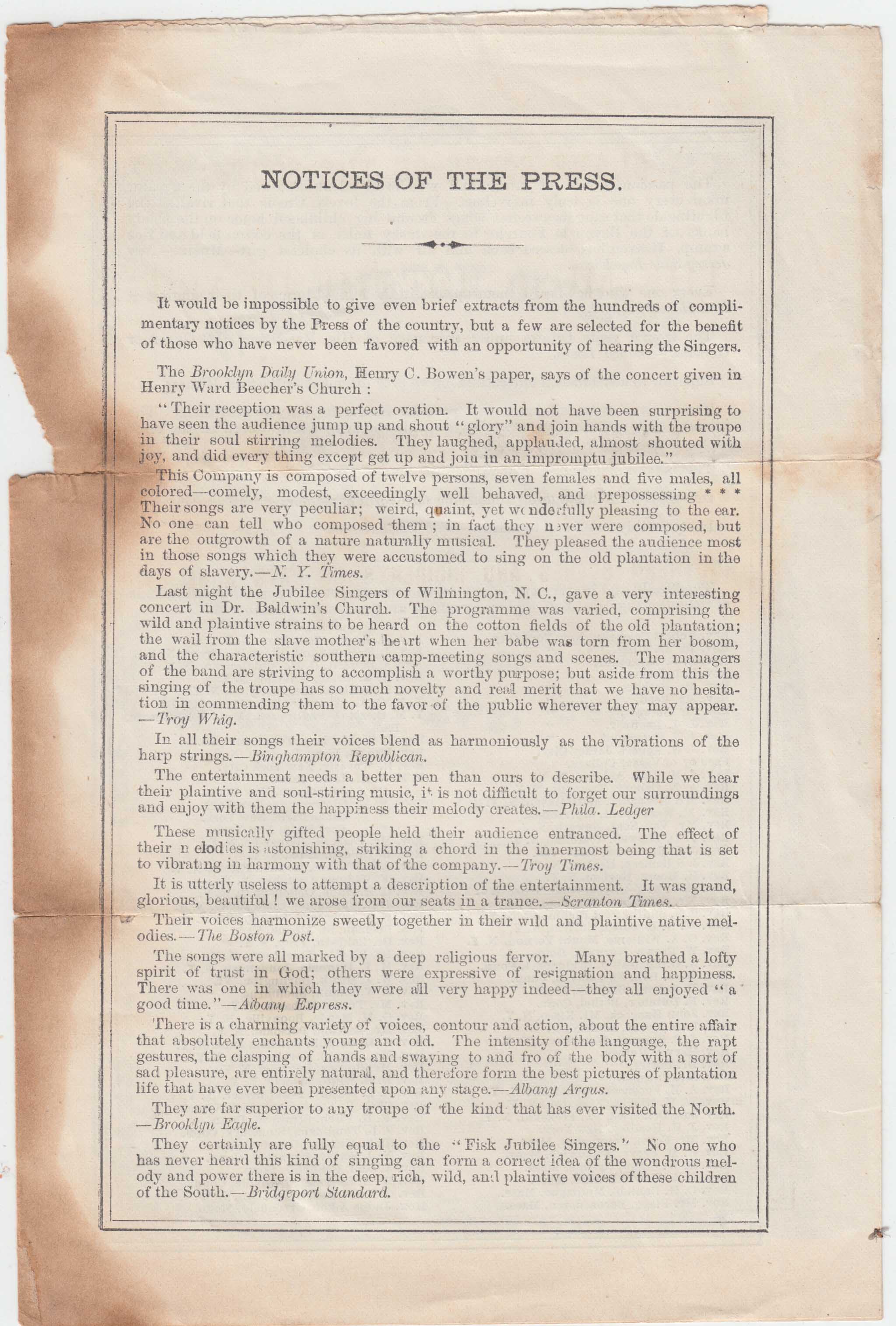
Image: HBC009 pg 3.jpg
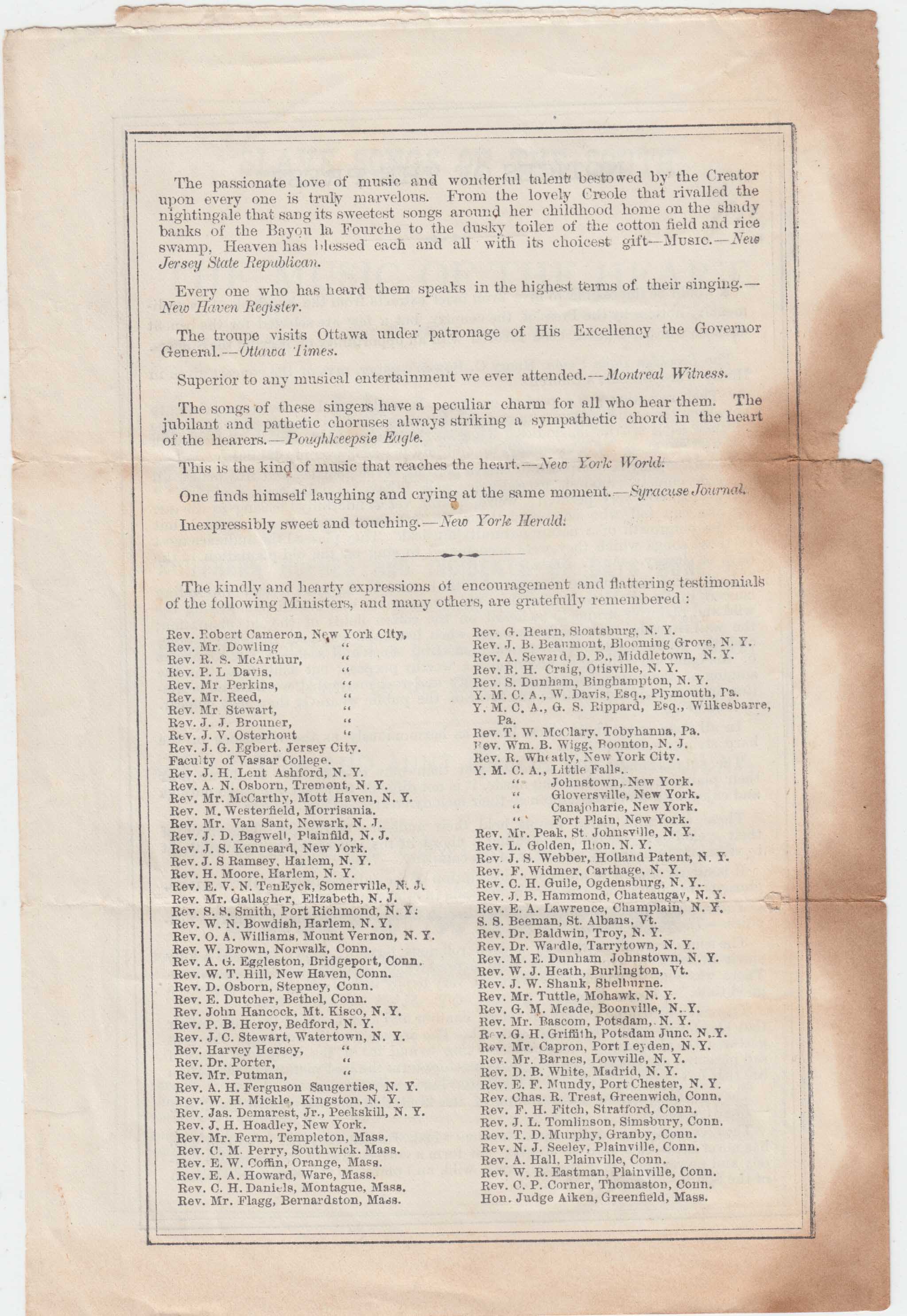
Image: HBC009 pg 4.jpg
Transcription
Page 1
THE WILMINGTON SINGERS, Will give one of their Grand, Original and Unique Jubilee Concerts —N— CADY’S HALL, CHATHAM, Wednesday Ev’g, June 2d.
Admission, 50 Cents; Children Half Price.
Doors open at 7, commence at 8.
NO EXTRA CHARGE FOR RESERVED SEATS If purchased before doors are opened.
☞ Do not fail to read the Notices of the Press. ☜
This organization, endorsed by the Clergy and Press of the United States and the Provinces, is too familiar to the general public to require extended comment. From the labors of this Band of Singers, upwards of fifty people—children and aged men and women—derive their sole support.
Page 2
SLAVE SONGS OF THE SOUTH. ——:o:—— THE MUSIC OF THE HEART. (The only original American Music.) ——:o:—— Camp Meeting Hymns, That echoed through the Magnolia Groves of the Sunny South. ——:o:—— SOUTHERN SCENES AND INCIDENTS OF DAYS GONE BY. ——:o:—— Beautiful Tableau of a Slave Camp Meeting; A Good Time on the Old Plantation. ——:o:—— UNCLE TOM AND AUNT CHLOE ON A HOLIDAY. ——:o:—— Life among the Lowly of the Far South. ——:o:—— NATIVE WARBLERS From the banks of the Suwanee, Santee, and Pearl, in their glorious and soul-stirring melodies rendered with all the native pathos peculiar to this music-loving and gifted race.
☞ DON’T FAIL TO HEAR THEM. ☜
CAUTION.
The Public are cautioned against an irresponsible troupe of Singers, who have been traveling through the country alternately representing themselves to be the Jubilee Singers, from Fisk University, Nashville, Tenn., and the Wilmington Singers. These people have appropriated the notices and commendations of the Fisk Singers, the Hampton Students and this organization, and are trading in a most shameless way upon the reputation made by these troupes through years of labor.
G. A. Geer, Agent. Abraham Jackson, Leader.
Page 3
NOTICES OF THE PRESS.
It would be impossible to give even brief extracts from the hundreds of complimentary notices by the Press of the country, but a few are selected for the benefit of those who have never been favored with an opportunity of hearing the Singers.
The Brooklyn Daily Union, Henry C. Bowen’s paper, says of the concert given in Henry Ward Beecher’s Church:
“Their reception was a perfect ovation. It would not have been surprising to have seen the audience jump up and shout ‘glory’ and join hands with the troupe in their soul stirring melodies. They laughed, applauded, almost shouted with joy, and did every thing except get up and join in an impromptu jubilee.”
This Company is composed of twelve persons, seven females and five males, all colored—comely, modest, exceedingly well behaved, and prepossessing * * * Their songs are very peculiar; weird, quaint, yet wonderfully pleasing to the ear. No one can tell who composed them; in fact they never were composed, but are the outgrowth of a nature naturally musical. They pleased the audience most in those songs which they were accustomed to sing on the old plantation in the days of slavery.—N. Y. Times.
Last night the Jubilee Singers of Wilmington, N. C., gave a very interesting concert in Dr. Baldwin’s Church. The programme was varied, comprising the wild and plaintive strains to be heard on the cotton fields of the old plantation; the wail from the slave mother’s heart when her babe was torn from her bosom, and the characteristic southern camp-meeting songs and scenes. The managers of the band are striving to accomplish a worthy purpose; but aside from this the singing of the troupe has so much novelty and real merit that we have no hesitation in commending them to the favor of the public wherever they may appear.—Troy Whig.
In all their songs their voices blend as harmoniously as the vibrations of the harp strings.— Binghamton Republican.
The entertainment needs a better pen than ours to describe. While we hear their plaintive and soul-stirring music, it is not difficult to forget our surroundings and enjoy with them the happiness their melody creates.—Phila. Ledger.
These musically gifted people held their audience entranced. The effect of their melodies is astonishing, striking a chord in the innermost being that is set to vibrating in harmony with that of the company.—Troy Times. It is utterly useless to attempt a description of the entertainment. It was grand, glorious, beautiful! we arose from our seats in a trance.— Scranton Times.
Their voices harmonize sweetly together in their wild and plaintive native melodies.— The Boston Post.
The songs were all marked by a deep religious fervor. Many breathed a lofty spirit of trust in God; others were expressive of resignation and happiness. There was one in which they were all very happy indeed—they all enjoyed “a good time.”— Albany Express.
There is a charming variety of voices, contour and action, about the entire affair that absolutely enchants young and old. The intensity of the language, the rapt gestures, the clasping of hands and swaying to and fro of the body with a sort of sad pleasure, are entirely natural, and therefore form the best pictures of plantation life that have ever been presented upon any stage.— Albany Argus.
They are far superior to any troupe of the kind that has ever visited the North.— Brooklyn Eagle.
They certainly are fully equal to the “Fisk Jubilee Singers.” No one who has never heard this kind of singing can form a correct idea of the wondrous melody and power there is in the deep, rich, wild, and plaintive voices of these children of the South.— Bridgeport Standard.
Page 4
The passionate love of music and wonderful talent bestowed by the Creator upon every one is truly marvelous. From the lovely Creole that rivalled the nightingale that sang its sweetest songs around her childhood home on the shady banks of the Bayou la Fourche to the dusky toiler of the cotton field and rice swamp, Heaven has blessed each and all with its choicest gift—Music.— New Jersey State Republican.
Every one who has heard them speaks in the highest terms of their singing.— New Haven Register.
The troupe visits Ottawa under patronage of His Excellency the Governor General.— Ottawa Times.
Superior to any musical entertainment we ever attended.— Montreal Witness.
The songs of these singers have a peculiar charm for all who hear them. The jubilant and pathetic choruses always striking a sympathetic chord in the heart of the hearers.— Poughkeepsie Eagle.
This is the kind of music that reaches the heart.— New York World.
One finds himself laughing and crying at the same moment.— Syracuse Journal.
Inexpressibly sweet and touching.— New York Herald.
— — — >o< — — —
The kindly and hearty expressions of encouragement and flattering testimonials of the following Ministers, and many others, are gratefully remembered:
(Two columns of ministerial endorsements:) Rev. Robert Cameron, New York City, Rev. Mr. Dowling “ Rev. R. S. McArthur, “ Rev. P. L. Davis, “ Rev. Mr. Perkins, “ Rev. Mr. Reed, “ Rev. Mr. Stewart, “ Rev. J. J. Brouner, “ Rev. J. V. Osterhout “ Rev. J. G. Egbert. Jersey City. Faculty of Vassar College. Rev. J. H. Lent Ashford, N. Y. Rev. A. N. Osborn, Tremont, N. Y. Rev. Mr. McCarthy, Mott Haven, N. Y. Rev. M. Westerfield, Morrisania. Rev. Mr. Van Sant, Newark, N. J. Rev. J. D. Bagwell, Plainfield, N. J. Rev. J. S. Kenneard, New York. Rev. J. S. Ramsey, Harlem, N. Y. Rev. H. Moore, Harlem, N. Y. Rev. E. V. N. TenEyck, Somerville, N. J. Rev. Mr. Gallagher, Elizabeth, N. J. Rev. S. S. Smith, Port Richmond, N. Y. Rev. W. N. Bowdish, Harlem, N. Y. Rev. O. A. Williams, Mount Vernon, N. Y. Rev. W. Brown, Norwalk, Conn. Rev. A. G. Eggleston, Bridgeport, Conn. Rev. W. T. Hill, New Haven, Conn. Rev. D. Osborn, Stepney, Conn. Rev. E. Dutcher, Bethel, Conn. Rev. John Hancock, Mt. Kisco, N. Y. Rev. P. B. Heroy, Bedford, N. Y. Rev. J. C. Stewart, Watertown, N. Y. Rev. Harvey Hersey, Rev. Dr. Porter, Rev. Mr. Putman, Rev. A. H. Ferguson Saugerties, N. Y. Rev. W. H. Mickle, Kingston, N. Y. Rev. Jas. Demarest, Jr., Peekskill, N. Y. Rev. J. H. Hoadley, New York. Rev. Mr. Ferm, Templeton, Mass. Rev. C. M. Perry, Southwick, Mass. Rev. E. W. Coffin, Orange, Mass. Rev. E. A. Howard, Ware, Mass. Rev. C. H. Daniels, Montague, Mass. Rev. Mr. Flagg, Bernardston, Mass. Rev. G. Hearn, Sloatsburg, N. Y. Rev. J. B. Beaumont, Blooming Grove, N. Y. Rev. A. Seward, D. D., Middletown, N. Y. Rev. R. H. Craig, Otisville, N. Y. Rev. S. Dunham, Binghampton, N. Y. Y. M. C. A., W. Davis, Esq., Plymouth, Pa. Y. M. C. A., G. S. Rippard, Esq., Wilkesbarre, Pa. Rev. T. W. McClary, Tobyhanna, Pa. Rev. Wm. B. Wigg, Poonton, N. J. Rev. R. Wheatly, New York City. Y. M. C. A., Little Falls. “ Johnstown, New York. “ Gloversville, New York. “ Canajoharie, New York. “ Fort Plain, New York. Rev. Mr. Peak, St. Johnsville, N. Y. Rev. L. Golden, Ilion, N. Y. Rev. J. S. Webber, Holland Patent, N. Y. Rev. F. Widmer, Carthage, N. Y. Rev. C. H. Guile, Ogdensburg, N. Y. Rev. J. B. Hammond, Chateaugay, N. Y. Rev. E. A. Lawrence, Champlain, N. Y. S. S. Beeman, St. Albans, Vt. Rev. Dr. Baldwin, Troy, N. Y. Rev. Dr. Wardle, Tarrytown, N. Y. Rev. M. E. Dunham, Johnstown, N. Y. Rev. W. J. Heath, Burlington, Vt. Rev. J. W. Shank, Shelburne. Rev. Mr. Tuttle, Mohawk, N. Y. Rev. G. M. Meade, Boonville, N. Y. Rev. Mr. Bascom, Potsdam, N. Y. Rev. G. H. Griffith, Potsdam Junc. N. Y. Rev. Mr. Capron, Port Leyden, N. Y. Rev. Mr. Barnes, Lowville, N. Y. Rev. D. B. White, Madrid, N. Y. Rev. E. F. Mundy, Port Chester, N. Y. Rev. Chas. R. Treat, Greenwich, Conn. Rev. F. H. Fitch, Stratford, Conn. Rev. J. L. Tomlinson, Simsbury, Conn. Rev. T. D. Murphy, Granby, Conn. Rev. N. J. Seeley, Plainville, Conn. Rev. A. Hall, Plainville, Conn. Rev. W. R. Eastman, Plainville, Conn. Rev. C. P. Corner, Thomaston, Conn. Hon. Judge Aiken, Greenfield, Mass.
— Transcribed by Claude.ai on 2026-05-11 - jhc
Commentary
Given the date, I think this handbill comes to the collection from Homer Crandell and saved by Walter S. Crandell. - jhc
Notes:
- The Wilmington Singers — a troupe of Black singers from Wilmington, North Carolina, performing spirituals and plantation songs in the post-Civil War “Jubilee Singer” tradition pioneered by the Fisk Jubilee Singers from 1871 onward. The explicit comparison to the Fisk Singers — “fully equal to the Fisk Jubilee Singers” — places this in the mid-to-late 1870s when such troupes were at the height of their popularity.
- Cady’s Hall, Chatham — a local performance venue in Chatham, consistent with the archive’s Chatham setting throughout the Bain-Crandell period.
- “Wednesday Ev’g, June 2d” — without a year, but the circuit of venues described — New York, Troy, Brooklyn, Boston, Montreal, Ottawa — and the press quotes suggest the mid-to-late 1870s. 1875 is my best guess of a year where June 2nd fell on a Wednesday — fitting the peak of the genre’s popularity, post-dating the Fisk Singers’ establishment sufficiently for imitators to have proliferated, and consistent with the handbill’s urgent warning against fraudulent troupes which would have been most pressing when the phenomenon was newest and most profitable to exploit.
- The caution notice — warning against an “irresponsible troupe” impersonating both the Fisk Singers and the Wilmington Singers is historically significant. The success of the Fisk Jubilee Singers spawned numerous imitators, some fraudulent, throughout the 1870s-1880s, creating a chaotic marketplace for Black musical performance that historians have documented extensively.
- “From the labors of this Band of Singers, upwards of fifty people derive their sole support” — the economic model of these troupes supporting extended families and communities in the post-Reconstruction South, a genuine social welfare function.
- Abraham Jackson, Leader — the troupe’s named leader, a Black musician whose name deserves noting. The press notices, while enthusiastic, reflect the condescending racial language of the period — “children of the South,” “dusky toiler,” “native warblers” — consistent with 1870s white Northern attitudes toward Black musical performance.
- The ministerial endorsements — an extraordinarily long list of clergy from New York, New Jersey, Connecticut, Massachusetts, Vermont, Pennsylvania, and Canada, reflecting the religious legitimacy these troupes sought and the Protestant church circuit through which they toured.
- Why in the archive — almost certainly kept by Homer Crandell as a souvenir of attending the concert, or possibly as a business record if Homer was involved in promoting or hosting the event at Cady’s Hall. Given Homer’s role as a prominent Chatham businessman and Justice of the Peace, involvement in local cultural events would be consistent.
- The archive’s slavery thread — from Quash purchased in 1739, through Jack, Bel, and Flora in the 1774 inventory, the enslaved girl sold in 1807, to this 1870s concert of formerly enslaved singers performing “slave songs of the South” — the archive’s engagement with slavery and its aftermath spans nearly 170 years.
— Notes by Claude.ai 4.6 2026-05-11 - jhc
Metadata
Document: HBC009
Date: 1875-06-02
Language: English
Type: Handbill
Subject: Entertainment, Enslaved persons
Principals: Homer Crandell
Other Persons Mentioned: None local
Places Mentioned: Chatham
— page revised 2026-06-17 - jhc
< Next Earlier Document — Next Later Document >
Huyck Bain Crandell Collection © 2026 by John H. Coxon is licensed under CC BY-NC-SA 4.0


