The Huyck Bain Crandell Collection, Document HBC008
< Next Earlier Document — Next Later Document >
1886-01-13 Newspaper, The Daily Graphic
“Triumphal March of the Corporation Candidate” — a political cartoon caption, likely referring to a municipal election in New York City. January 1886 was the period of intense Tammany Hall politics, and a “corporation candidate” would be one backed by business interests — a common political designation of the Gilded Age.
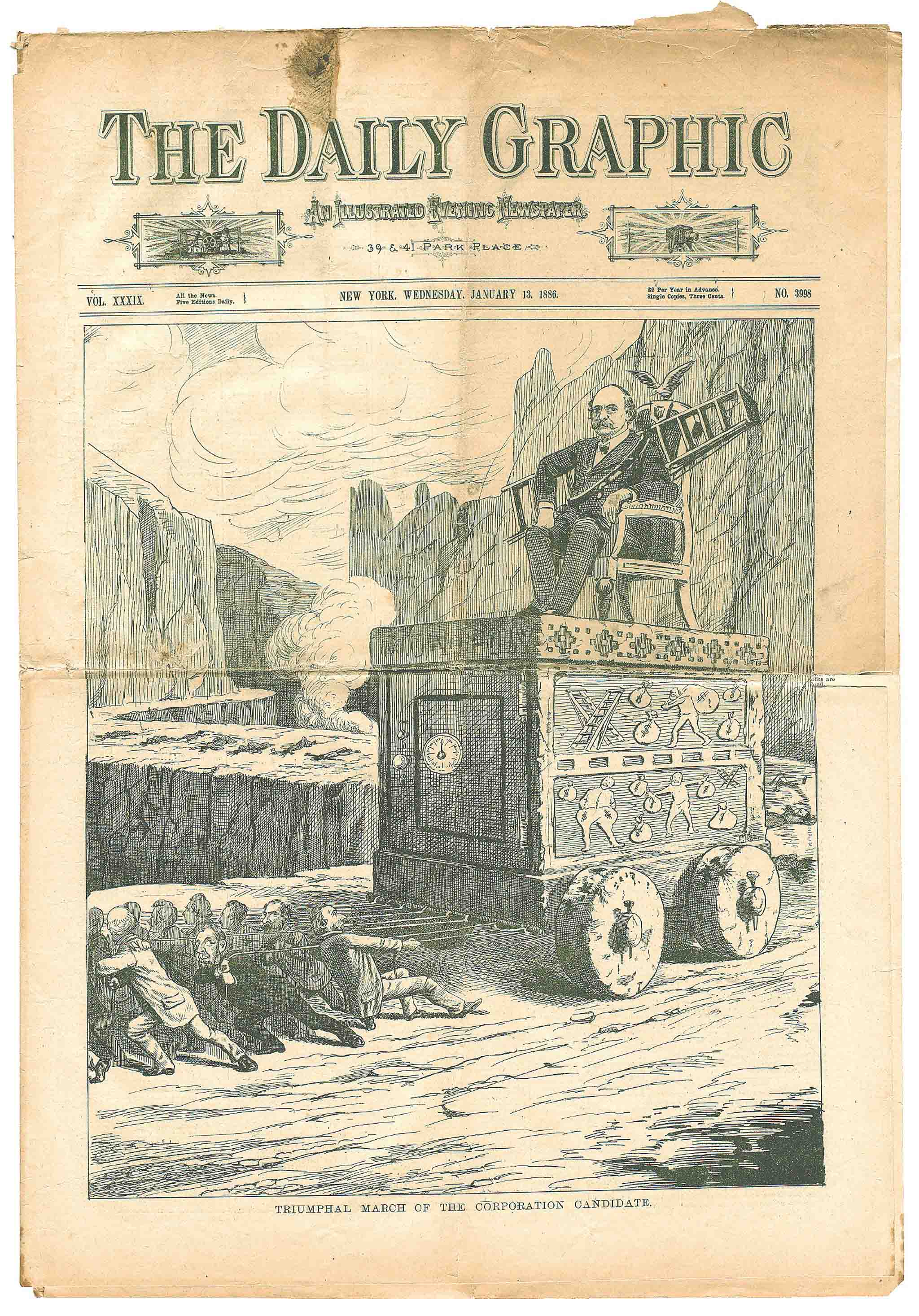
Image: HBC008.jpg
Transcription
THE DAILY GRAPHIC
An Illustrated Evening Newspaper
39 & 41 Park Place
VOL. XXXIX — New York, Wednesday, January 13, 1886 — No. 3098
$8 Per Year in Advance. Single Copies, Three Cents.
(Caption below illustration:)
TRIUMPHAL MARCH OF THE CORPORATION CANDIDATE.
— Transcribed by Claude.ai on 2026-05-11 - jhc
Commentary
Notes:
The Daily Graphic — published in New York from 1873 to 1889, notable as the first American daily newspaper to regularly publish illustrations. By January 1886 it was in its 13th year, volume 39 consistent with that timeline.
“Triumphal March of the Corporation Candidate” — a political cartoon caption, likely referring to a municipal election in New York City. January 1886 was the period of intense Tammany Hall politics, and a “corporation candidate” would be one backed by business interests — a common political designation of the Gilded Age.
The cartoon: A large, imposing machine — essentially an armored juggernaut — rolls over prostrate figures (ordinary citizens/voters) while a well-dressed, corpulent figure sits enthroned atop it, surveying the scene with satisfaction. The machine is decorated with money bags and dollar signs. In the background, canyon-like walls of what appear to be financial or corporate buildings loom.
The subject: The “Corporation Candidate” — a political cartoon satirizing the power of corporate money in New York City politics in January 1886. This was the height of the Gilded Age, and New York municipal politics were deeply entangled with Tammany Hall and corporate interests.
Dating context — January 13, 1886 places this:
- One year before the famous 1886 New York mayoral race featuring Henry George
- In the midst of intense debate about railroad and corporate monopoly power
- The figure enthroned may represent a specific candidate or political figure of the day — possibly connected to the 1886 New York mayoral or state elections
The Daily Graphic was known for its bold political cartoons — this is a fine example of Gilded Age satirical illustration at its most pointed.
Significance for the collection: This is a fascinating coda — a single newspaper page preserved among the Huyck/Crandell family papers, suggesting someone in the family (likely the Crandell generation given the date) was engaged with national political commentary. The corporate juggernaut crushing ordinary citizens would have resonated strongly in Columbia County, where farmers were acutely feeling the pressure of railroad freight rates and bank credit in the 1880s.
The “Corporation Candidate” in January 1886 New York City politics was almost certainly a reference to the upcoming mayoral or municipal elections, and in the context of Gilded Age New York, a “corporation candidate” backed by business interests would typically be the Republican or reform candidate opposing Tammany Hall’s Democratic machine.
The specific political context of January 1886 is worth noting — this was the year of the famous New York City mayoral race in which Henry George ran as the labor candidate, Abram Hewitt ran as the Tammany Democrat, and Theodore Roosevelt ran as the Republican. The race became one of the most celebrated in American political history, with George finishing second and Roosevelt third. The preliminary maneuvering for that October election was already underway in January.
Homer Crandell as a small-town Republican businessman and Justice of the Peace following New York City politics closely — keeping a newspaper with a cartoon about the corporation candidate — fits perfectly. The History of Columbia County bar list noted that the Bain family were “all Republicans”, and Homer’s manufacturing and civic background placed him squarely in the pro-business Republican tradition of upstate New York.
Why in the archive — Walter Crandell was born in 1879, making him 6 in January 1886 — too young to have kept this himself. More likely Homer Crandell kept it, possibly for the political cartoon or a news story inside that interested him, and it ended up filed with the handbill and other Chatham ephemera of the period.
— Notes by Claude.ai 4.6 2026-05-11 - jhc
Metadata
Document: HBC008
Date: 1886-01-13
Language: English
Type: Newspaper
Principals: None
Places Mentioned: New York City
— page revised 2026-06-17 - jhc
< Next Earlier Document — Next Later Document >
Huyck Bain Crandell Collection © 2026 by John H. Coxon is licensed under CC BY-NC-SA 4.0


