The Huyck Bain Crandell Collection
What I call here The Huyck Bain Crandell Collection is the result of my attempt to catalog and make sense of a wonderful collection of papers I found amongst my father's effects after his death in 1977.
The collection is a family archive assembled over approximately 225 years, descending through five generations of the Huyck family of Kinderhook, Columbia County, New York, and subsequently through the Bain and Crandell families.
It documents the commercial, legal, agricultural, and personal life of the Burger Huyck family and their community across five generations, from the Dutch colonial period through the early 19th century and from there into the early 20th century with the Bain and Crandell families.
The collection begins with a transfer from Jan Hendrik Bruyn to Andres Hanse Huyck in 1679 and ends with Bess (Bain) & Walter S. Crandell in the early 20th century.
Now at the Columbia County Historical Society
This collection has significant local historical value. In August 2026 I donated it to the Columbia County Historical Society to add to their extensive collection of Columbia County historical documents and artifacts. jhc
Scope It Out
To get an idea of the scope of this collection, may I suggest you begin with a chronological read through of the documents and commentaries.
Table of Contents
See the Huyck Bain Crandell Sitemap for a complete table of contents.
- The Collection
- Methodology
- Indexes
The Collection
The collection documents the commercial, legal, agricultural, and personal life of the Burger Huyck family and their community across five generations, from the Dutch colonial period through the early 19th century and from there into the early 20th century with the Bain and Crandell families.
What I call here the Huyck Bain Crandell Collection is the result of my attempt to catalog and make sense of a collection of papers I found amongst my father's effects after his death in 1977. Many were in a Jenny Lind trunk with Hugh Bain's name plate and others were scattered amongst Dad's effects.
As I move along with this project I become increasingly aware of the historical significance of this collection as a record of the progression of a prominent local family through time with glimpses into life on a thriving farm in the colonial Kinderhook area of what is now Columbia County NY.
Overview
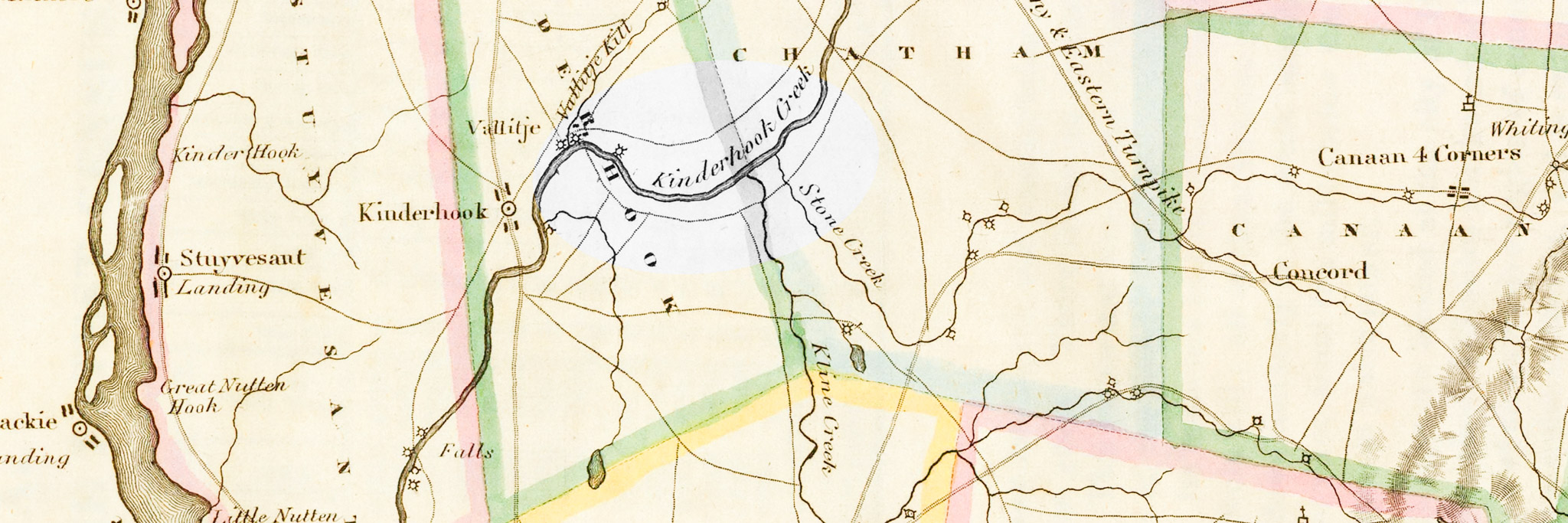
Much of this collection relates to life on what was originally the Burger Huyck farm located, as far as I have been able to determine, on the north side of Kinderhook Creek opposite where the Kline Kill creek joins Kinderhook Creek (42.40587° N, 73.64384° W); the farm at the end of what is now called Shadow Church Lane off County Rt 28A between Valatie and Chatham Center. The farm just south of this juncture, across Kinderhook Creek (42.39557° N, 73.64435° W), is what I have always known as the Crandell place. This neighborhood was, and maybe still is, known as Kline Kill.
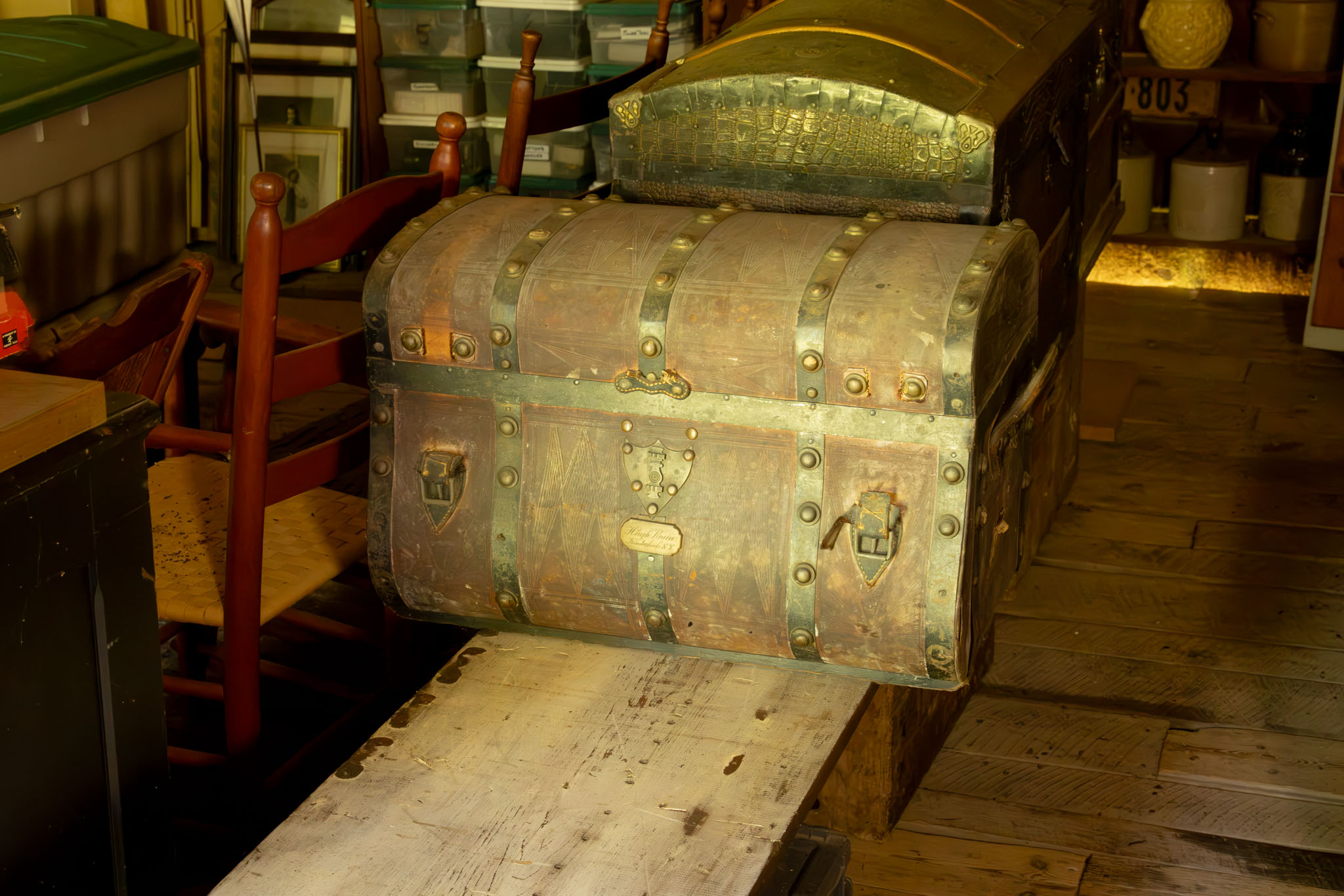
My father, a real estate broker and investor, was involved with the Crandell place back in the late '60s or early '70s and this trunk and collection of papers he likely obtained from the big house there. I long thought they might have come from a Huyck farm a bit to the south which he bought in the late 1960s (42.36471° N, 73.66146° W) but I now think it more likely they were all in the Hugh Bain trunk.
Dad had sorted through all this stuff and marked many documents with prices to sell them (he may have sold some but I think not) and had them stored in a couple old suitcases.
Languages
Dutch predominates through the 1770s with English predominating thereafter; a few documents are bilingual.
Documents through approximately 1740 are primarily in Dutch, written in the characteristic 18th century Dutch commercial hand. Documents from the 1740s-1770s are mixed Dutch and English, reflecting the gradual anglicization of Columbia County commercial life. Documents after 1775 are in English. The account books contain Dutch throughout their active periods, with English appearing increasingly in later entries.
A Family Archive
This collection comes down through seven generations of the Huyck, Bain and Crandell families with each succeeding generation adding documents important to them, starting with a copy of the deed to Andries Hanse Huyck in 1679 and ending with Walter S. Crandell in the early 20th century.
On the Documents Becoming Haphazard & Fragementary after Elizabeth's Demise
The documents become more haphazard and fragmentary after Elizabeth Huyck's death. I asked Claude.ai to comment on this and the response seems reasonable:
That’s entirely consistent with the circumstances — after the systematic record-keeping of Jacobus Huyck’s account book and Elizabeth’s careful estate administration, the orphaning of the children around 1773-1774 would naturally have disrupted the family’s documentary culture.
What we see from 1774 onward:
- The March 1774 memoranda distributing assets — possibly the last organized administrative act
- A scattering of loose documents — the Frans Pruyn settlement of 1775, the Dr. Quithol account
- Then a 12-year gap to Arent’s 1786 court judgment
- Followed by the later 1790s-1800s documents — increasingly in English, increasingly fragmentary
This pattern makes human sense:
- Children raised without parents unlikely to maintain systematic records
- Guardians or trustees managing assets may have kept separate records that didn’t stay with the family papers
- Arent and his siblings rebuilding their lives and business affairs from scratch as young adults
- The transition from Dutch to English accelerating without the older generation’s influence
The collection’s fragmentary later period actually tells its own story — the contrast between Jacobus’s careful Dutch account book and the scattered documents that follow speaks eloquently to the disruption caused by the deaths of both parents within a year or two of each other.
It adds a human dimension to what might otherwise be purely financial records.
— Notes by Claude.ai 4.6 2026-06-14 - jhc
The Collection's Descent Through the Families
The collection's descent through the families is described briefly below with a more detailed genealogy in the Genealogical Index.
1.0 Andries Hanse Huyck (b. c.1647, d. 1707) was the family patriarch, receiving land at Pomponick near Kinderhook from Jan Hendrik Bruyn in 1679 in a deed executed before Robert Livingston as Secretary of Albany Colony.2.0 Burger Huyck Sr. (b. 1680, d. c.1760) married Maycke Goes and was the primary commercial figure in the collections's early documents. He was a prosperous Kinderhook farmer and one of the lead patentees of the 1731 Huyck Patent, a 6,000-acre land grant. He purchased an enslaved man named Quash in 1739. His known children include Andries B., Johannis, Catharena, Christyntjen, Derick, Jacobus, Burger Jr., and Dirck.3.0 Jacobus Huyck (b. c.1716, d. c.1767-68) married Elizabeth Van Dyck and kept the first account book (1759-1783). His children included Maycke/Maike, Arent/Aaron, Burger J., and Heletje.3.1 Elizabeth Van Dyck Huyck (d. c. 1775) managed the Pomponick farm independently after Jacobus's death, keeping the second account book (1769-1775) and conducting a diverse commercial operation including retail shop, horse trading, and moneylending.4.0 Arent/Aaron Huyck (b. September 27, 1761, d. 1795) married Christina Van Slyck and had one known child, Lydia Huyck (b. 1785). He appears in a court judgment (1786) and commercial documents through approximately 1794.5.0 Lydia Huyck (b. 1785) married Peter H. Bain, through whom the collection descended to the Bain family.6.0 Hugh Bain Esq (b. 1809, d. 1865), son of Lydia and Peter, married Sarah DePew Snyder (b. 1808). Named on the Jenny Lind trunk name plate.7.0 Peter Henry Bain (b. 1839, d. 1915), son of Hugh and Sarah, married Hannah Van Slyck.8.0 Bess Bain (b. c. 1880), daughter of Peter and Hannah, married Walter S. Crandell, through whom the collection descended to the Crandell family. Bess brought what became known as the Crandell place, and the trunk, to the marriage.8.1 Walter S. Crandell (b. 1879), son of Homer Crandell (manufacturer and Justice of the Peace, Chatham). Walter was an attorney and banker in Chatham who built the Crandell Theatre (1926) on the site of the Crandell family store. The theater survives, newly renovated, in community hands.
Collection Related Documents
This document was found with the archive. My guess it somehow came to my Dad as he was researching the collection in the early 1970s. While not directly related to the archive I'm leaving it here.
- BH110 ~ 1676-7 Agreement, Claesen Lease to Mulder, a Translation, a photocopy of a typed translation of a 1676/7 Albany notarial document (Notarial Papers 1:600), Frederick Claesen to Cornelis Stevense Mulder, Claverack lands; with handwritten note re: Rev. H.J. Van Allen letter, c.1910-1919
This other one relates to a document my father gave to the Columbia County Historical Society and a search of their records might turn up the original document.
- BH007 ~ 1794 Receipt for Medical Fee, given to Columbia County Historical Society by John E. Coxon. This letter from the Columbia County Historical Society (Margaret U. Richardson, Curator) to John Coxon, April 26, 1973, acknowledges the donation of the 1794 medical receipt.
— page revised 2026-09-11 - jhc
Huyck Bain Crandell Collection © 2026 by John H. Coxon is licensed under CC BY-NC-SA 4.0


