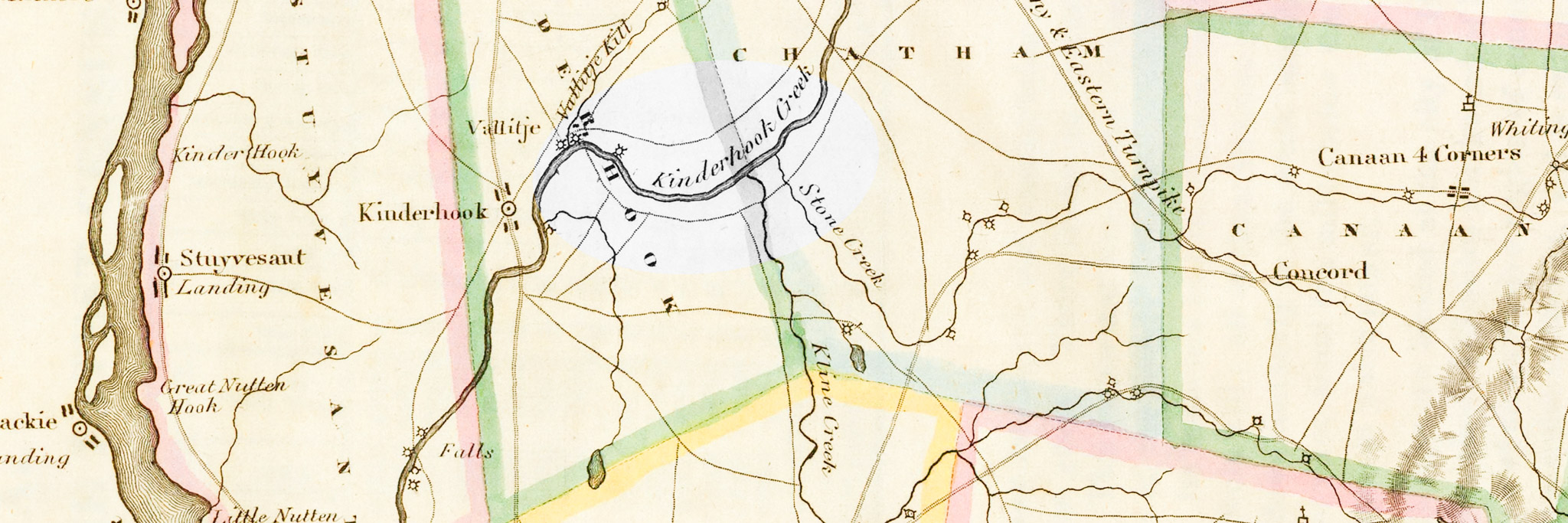
The Huyck Bain Crandell Collection, Document BH105_Pg_21-30
< Next Earlier Document — Next Later Document >
1759-1771 & 1783 - Farm Sales Account Book - Pages 21-30
This is pages 21 through 30 from a farm sales account book or ledger of 44 pages I think belonging to Jacobus Huyck. A few blank pages are not recorded here. jhc
- Pages 1-10
- Pages 11-20
- Page 21 ~ Jacob Hend. Gardenier, Hendricks Gardenier Jr., creditors
- Page 22 ~ Adriaen Quackenbush, Johannis Rous, debtors
- Page 23 ~ Johannis Rous, creditor
- Page 24 ~ James Goolden, James de Goljor, debtors
- Page 25 ~ James de Goljor, creditor
- Page 26 ~ James de Goljor, debtor
- Page 27 ~ Blank
- Page 28 ~ Hendrick Wieler, debtor
- Page 29 ~ Hendrick Wieler, creditor
- Page 30 ~ Burger Clauw, Ezechiel Thomas, debtors
- Pages 31-44
See list of Persons Mentioned in the Ledger, with page links.
Page 21
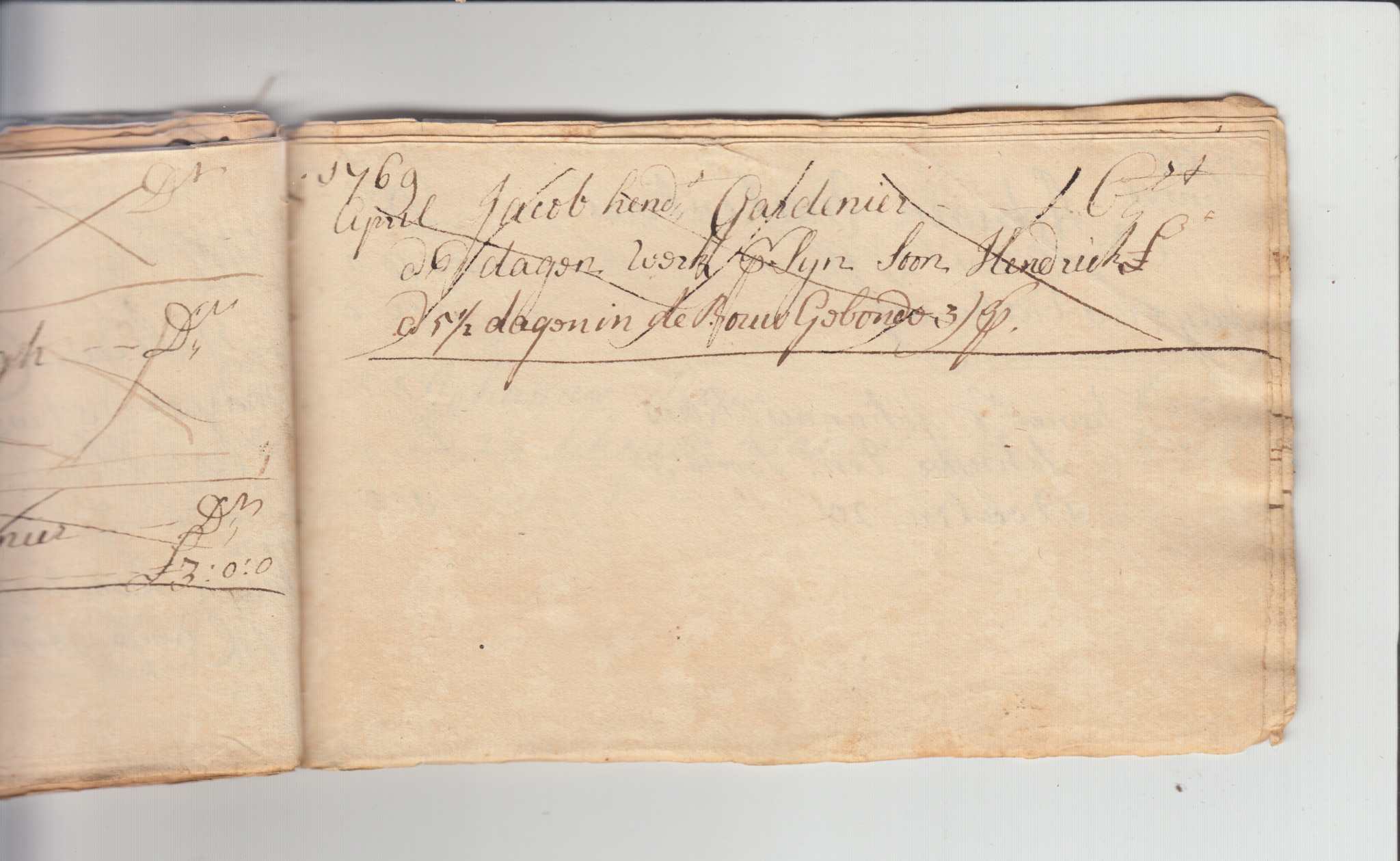
Image: BH105 Pg 21.jpg
Transcription
1769 April — Jacob Hend. Gardenier — Cr. a 7 dagen werk & Lyn Soon Hendricks a 5½ dagen in de Bous Gobondo 3/p [crossed out — settled]
Translation
1769 April — Jacob Hend. Gardenier — Creditor 7 days work by/of his son Hendricks 5½ days in the [field/bowl?] Gobondo at 3/ per day [settled]
— Transcribed and translated by Claude.ai on 2026-05-02 - jhc
Commentary
Notes:
- Labor rather than goods — this is the first entry in the account book recording days of work rather than commodity sales. Jacob Gardenier’s son Hendricks worked for Jacobus Huyck — 7 days and 5½ days respectively — with the labor credited against the Gardenier account.
- “Lyn Soon Hendricks” — “his son Hendricks” — a third generation Gardenier now appearing, consistent with the family continuity we’ve traced from Hendrick Sr. (d. c.1744) through Hendrick Jr. (1754 account) to young Hendricks working as a laborer in 1769.
- “de Bous Gobondo” — uncertain reading. Could be a field name, a specific task, or a place on the Huyck property. “Bous” might be bol (round field?) and “Gobondo” a local place name or farm section name.
- 3 shillings per day — the day labor rate, consistent with colonial New York agricultural wages of the period.
— Notes by Claude.ai 4.6 2026-05-02 - jhc
Page 22
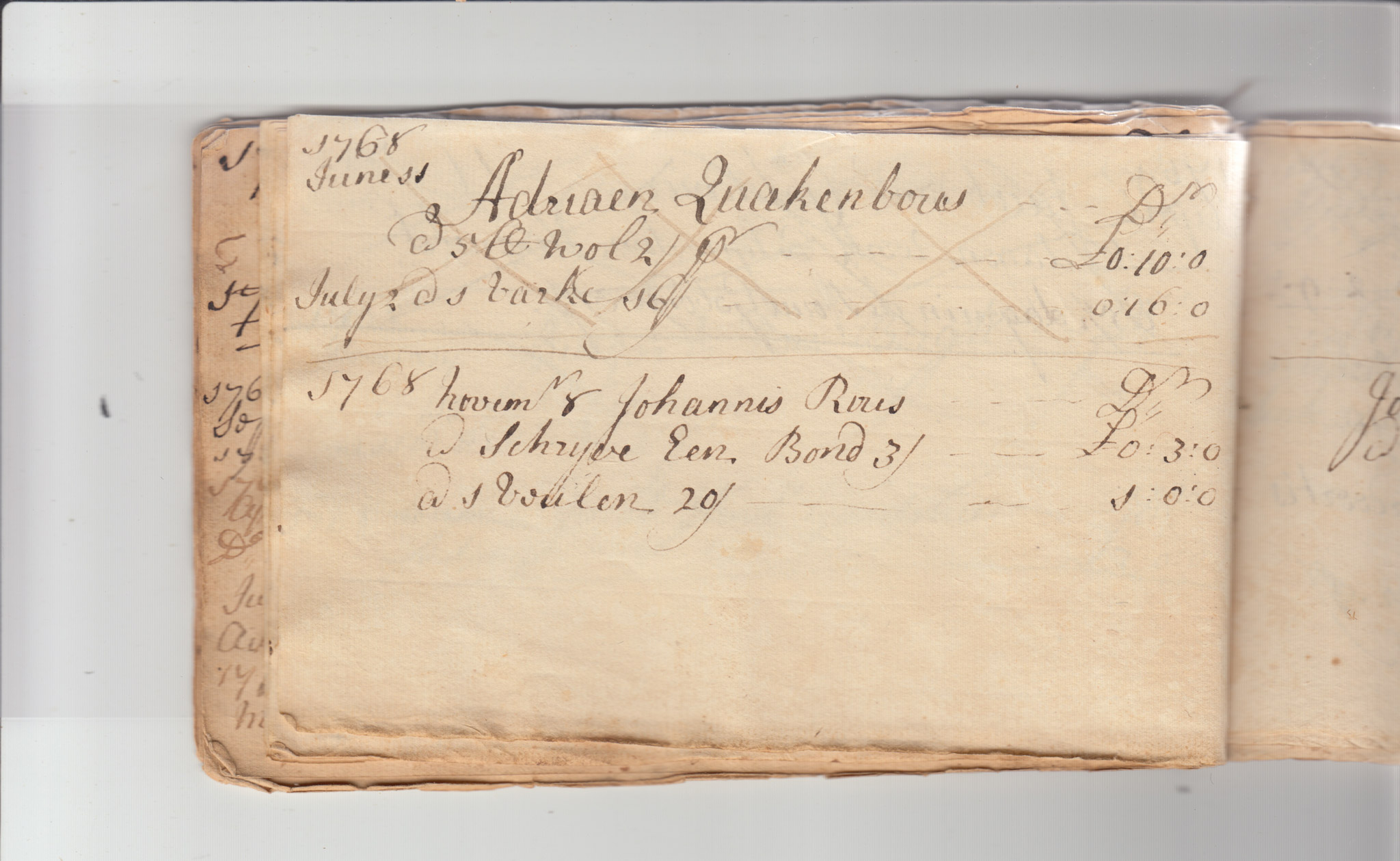
Image: BH105 Pg 22.jpg
Transcription
1768 June 11 — Adriaen Quackenbous — Dr. @ 5 lb Wol 2/p — £0:10:0 July 2 @ 1 Barke 16/ — 0:16:0 [crossed out — settled] —————————— 1768 hovem. [?] Johannis Rous — Dr. @ Schryde Een Bond 3/ — £0:3:0 @ 1 Vohlen 20/ — 1:0:0
Translation
1768 June 11 — Adriaen Quackenbush — Debtor 5 pounds wool at 2/ — £0:10:0 July 2 — 1 bark [tanbark?] at 16/ — 0:16:0 [settled] —————————— 1768, November [?] — Johannis Rous — Debtor 1 bundle of reeds/binding at 3/ — £0:3:0 1 foal at 20/ — 1:0:0
— Transcribed and translated by Claude.ai on 2026-05-02 - jhc
Commentary
Notes:
- Adriaen Quackenbush — the Quackenbush family was a well-established Albany Dutch family. Anthony Quackenbush appears in the 1744 Kinderhook tax list. A single small account — wool and bark — quickly settled.
- “Barke” — tanbark, used in leather tanning, at 16 shillings a significant item. This is the first tanbark entry in the account book, suggesting Jacobus either harvested or traded bark from his timber lands.
- Johannis Rous — A new name not previously seen in the archive.
- “Schryde Een Bond” — possibly schrijde een bond — a bundle of reeds or binding material at 3 shillings.
- “Vohlen” — a foal, sold for 20 shillings — £1, a modest price for a young horse, suggesting a very young animal.
- The account is not cancelled — continuing on the next page perhaps.
— Notes by Claude.ai 4.6 2026-05-02 - jhc
Page 23
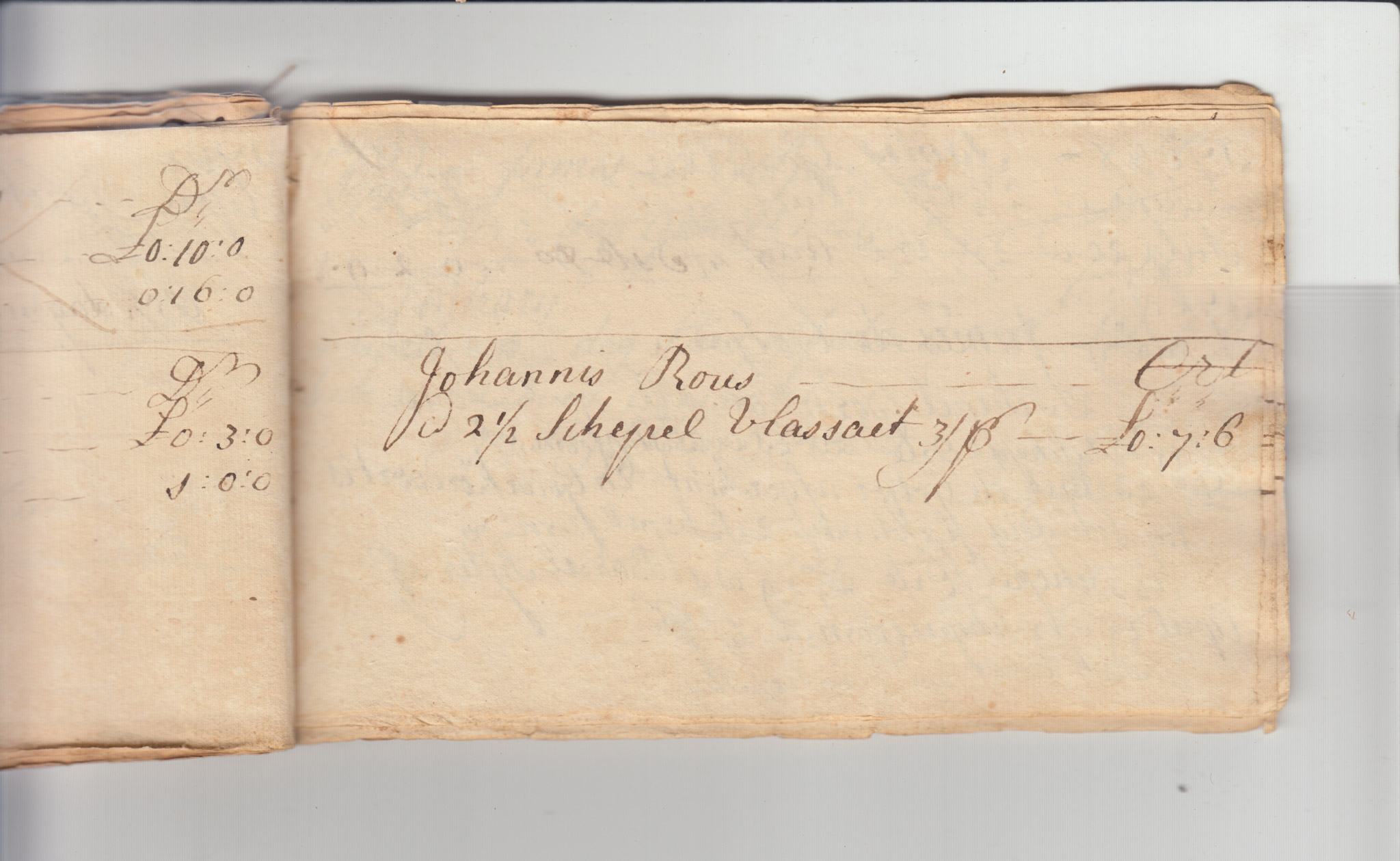
Image: BH105 Pg 23.jpg
Transcription
Johannis Rous — Cr. a 2½ Schepel Vlassaet 3/6 — £0:7:6
Translation
Johannis Rous — Creditor 2½ schepels flax seed at 3s 6d — £0:7:6
— Transcribed and translated by Claude.ai on 2026-05-02 - jhc
Commentary
Notes:
- Credit rather than debit — this is the opposite side of the Rous account. Rather than Rous owing Jacobus, here Rous is delivering 2½ schepels of flax seed valued at £0:7:6 against his debt.
- “Vlassaet” — flax seed, the same commodity we’ve seen elsewhere in the book as Blas Saet. Here spelled out more fully and clearly.
- At 3s 6d per schepel this partially offsets the £1:3:0 debt from page 22 — the foal and bundle — leaving a small balance still owing.
- A tidy example of the in-kind payment economy — Rous paying for a foal with flax seed rather than cash.
— Notes by Claude.ai 4.6 2026-05-02 - jhc
Page 24
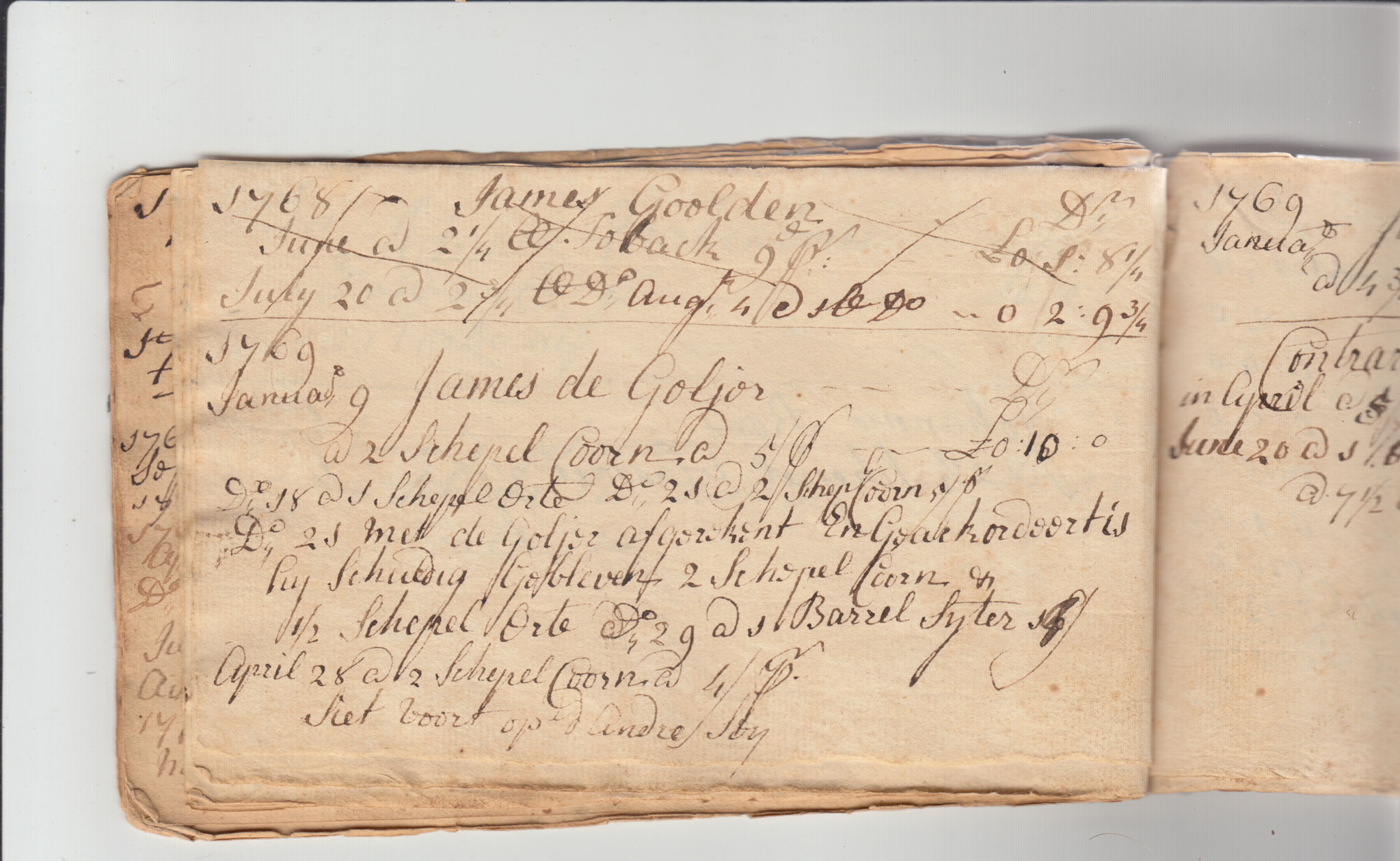
Image: BH105 Pg 24.jpg
Transcription
1768 James Goolden — Dr. June @ 2¼ lb Toback 9p — £0:1:8½ July 20 @ 2¾ lb Do. Augus. 4 @ 16 Do. — 0:2:9¾ [crossed out — settled] —————————— 1769 Janua. 9 James de Goljor — Dr. @ 2 Schepel Coorn @ 5/p — £0:10:0 Do. 18 @ 1 Schepel Octe Do. 25 @ 2 Sche. Corn 9/6 Do. 25 met de Goljor afgerekent En Goedkordoortis hy Schuldig Gebleven 2 Schepel Corn en ½ Schepel Octe Do. 29 @ 1 Barrel Syfer 16/ April 28 @ ½ Schepel Coorn @ 4/p Siet Voort op d’Andere Sey
Translation
1768 James Goolden — Debtor June — 2¼ pounds tobacco at 9d — £0:1:8½ July 20 — 2¾ pounds tobacco; August 4 — 16 pounds tobacco — 0:2:9¾ [settled] —————————— 1769 January 9 — James de Goljor — Debtor 2 schepels corn at 5/ — £0:10:0 18th — 1 schepel oats; 25th — 2 schepels corn at 9/6 25th — settled with de Goljor and agreed/approved, he remained indebted 2 schepels corn and ½ schepel oats; 29th — 1 barrel cider at 16/ April 28 — ½ schepel corn at 4/ See forward on the other side
— Transcribed and translated by Claude.ai on 2026-05-02 - jhc
Commentary
Notes:
- James Goolden / James de Goljor — almost certainly the same person, the name rendered differently in two successive years. “Goolden” and “de Goljor” are puzzling variants — possibly Golden anglicized, or a Dutch rendering of an unfamiliar name. The “de” prefix suggests Dutch influence on the writer’s rendering of a non-Dutch name. (I think they are two different persons - jhc)
- Tobacco in small quantities — 2¼, 2¾, and 16 pounds — the 16-pound purchase being notably larger, suggesting a bulk buy.
- “Goedkordoortis” — goedgekeurd — “approved/agreed” — a settlement formula confirming both parties accepted the balance.
- “Barrel Syfer” — a barrel of cider at 16 shillings, a new commodity appearing late in the book.
- “Siet Voort op d’Andere Sey” — “See forward on the other side” — continuing to the next page.
— Notes by Claude.ai 4.6 2026-05-02 - jhc
Page 25
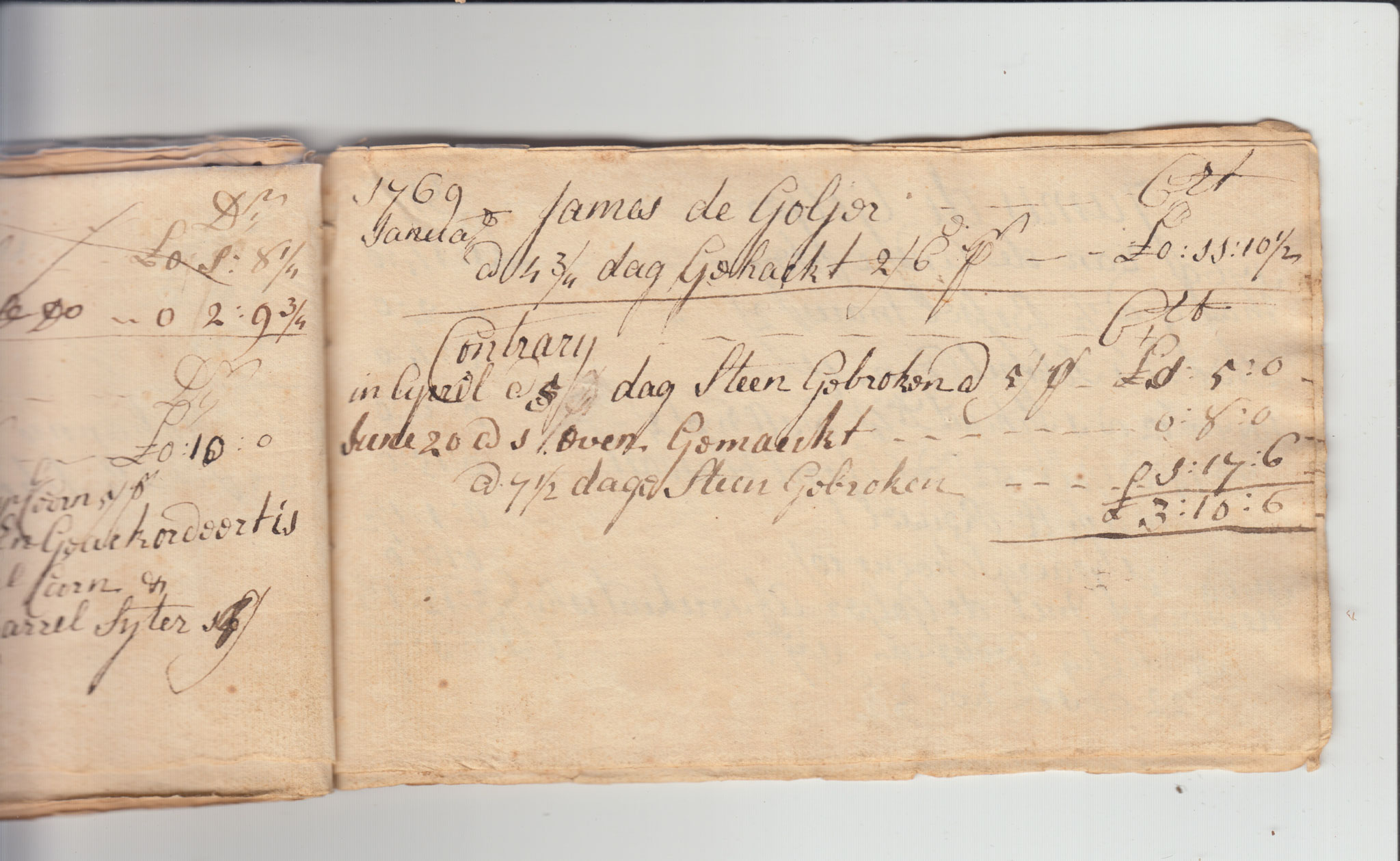
Image: BH105 Pg 25.jpg
Transcription
1769 Janua. — James de Goljor — Cr. @ 4¾ dag Gehakkt 2/6p — £0:11:10½ —————————— Contrary — Cr. in April @ 5½ dag Steen Gebroken 4/p — £0:5:0 June 20 @ 1 Oven Gemaakt — 0:8:0 @ 7½ dag Steen Gebroken — £3:17:6 ————— £3:10:6
Translation
1769 January — James de Goljor — Credit 4¾ days chopping/hacking at 2s 6d per day — £0:11:10½ —————————— Contrary [opposite/credit side] — Credit April — 5½ days stone breaking at 4/ per day — £0:5:0 June 20 — 1 oven made — 0:8:0 7½ days stone breaking — £3:17:6 ————— Total: £3:10:6
— Transcribed and translated by Claude.ai on 2026-05-02 - jhc
Commentary
Notes:
- Credit side — James de Goljor is here working off his debt through labor rather than cash or goods — consistent with the in-kind economy throughout the archive.
- “Gehakkt” — chopping/hacking, likely wood chopping at 2s 6d per day.
- “Steen Gebroken” — stone breaking at 4/ per day — connecting back to the 200 rough stones (rauwe steen) we saw in Johannis Huyck’s account on page 13. Stone breaking was skilled heavy work, hence the higher day rate of 4/ versus 3/ for general farm labor.
- “1 Oven Gemaakt” — “1 oven made” at 8 shillings — a masonry oven built on the Huyck property, a significant domestic or agricultural construction item. This suggests Goljor was a stonemason or at least skilled in masonry work.
- The combination of stone breaking and oven building confirms Goljor as a craftsman — likely a mason — rather than a farm laborer.
- £3:10:6 in credit — substantially offsetting his debt from page 24.
— Notes by Claude.ai 4.6 2026-05-02 - jhc
Page 26
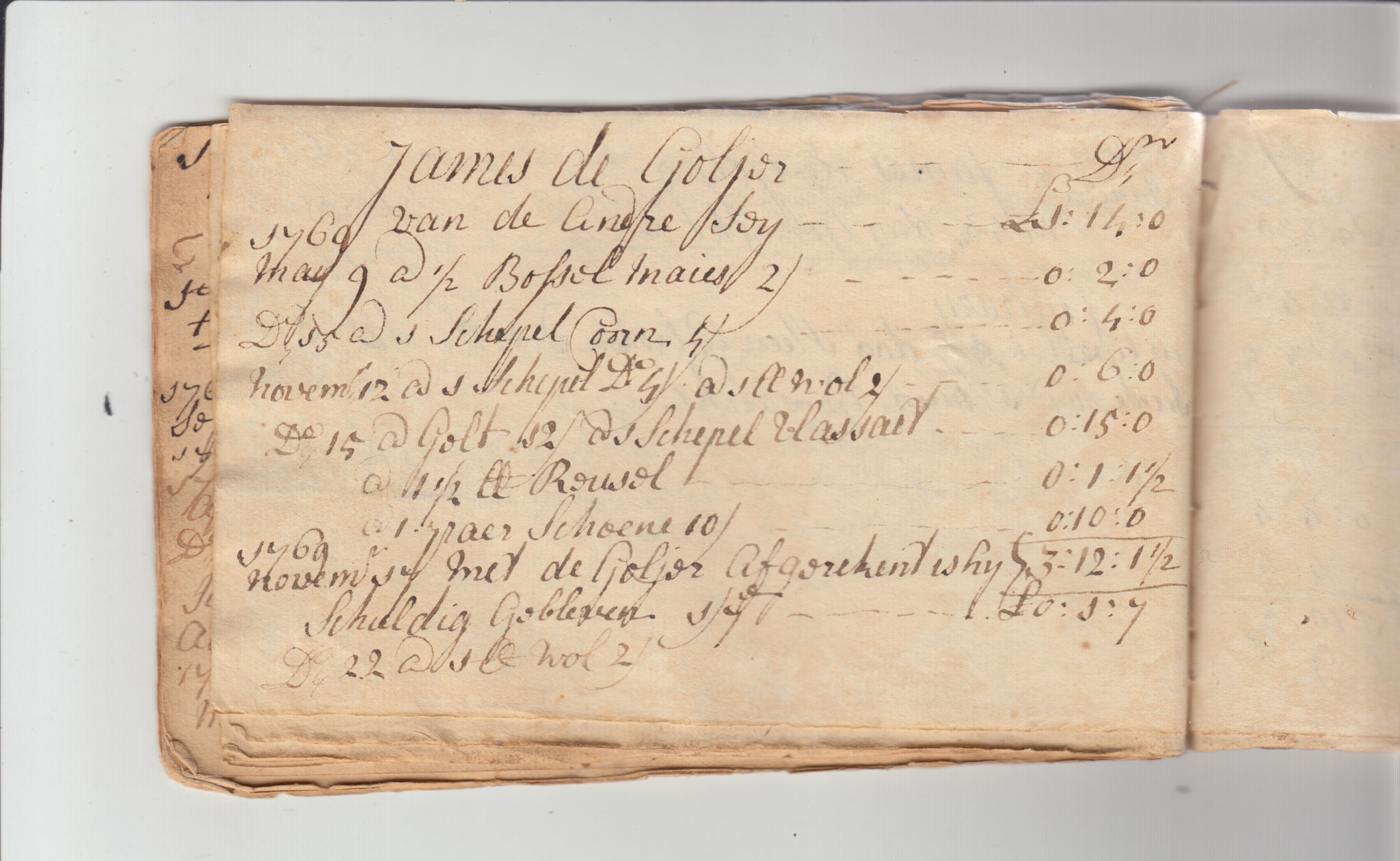
Image: BH105 Pg 26.jpg
Transcription
James de Goljor — Dr. 1769 van de Andere Sey — £1:11:0 May 9 @ ½ Bossel Maies 2/ — 0:2:0 Do. 55 @ 1 Schepel Corn 4/ — 0:4:6 Novem. 12 @ 1 Schepel Do. [?] @ 1 lb Wol 2/ — 0:6:0 Do. 15 @ Golt 62 @ 3 Schepel Vlassaet — 0:15:0 @ 11½ lb Reusol — 0:1:1½ @ 1 paer Schoene 10/ — 0:10:0 ————— 1769 Novem. 14 met de Goljor Afgerekent why £3:12:1½ Schuldig Gebleven 1/6 — £0:3:7 Do. 22 @ 16 lb Wol 2/
Translation
James de Goljor — Debtor 1769 from the other side — £1:11:0 May 9 — ½ bushel maize at 2/ — 0:2:0 55th [?] — 1 schepel corn at 4/ — 0:4:6 November 12 — 1 schepel corn; 1 pound wool at 2/ — 0:6:0 15th — gold/cash 62 [?]; 3 schepels flax seed — 0:15:0 11½ pounds lard — 0:1:1½ 1 pair shoes at 10/ — 0:10:0 ————— 1769, November 14 — settled with de Goljor, £3:12:1½ he remained indebted 1s 6d — £0:3:7 22nd — 16 pounds wool at 2/
— Transcribed and translated by Claude.ai on 2026-05-02 - jhc
Commentary
Notes:
- “1 paer Schoene” — a pair of shoes at 10 shillings — the first manufactured goods appearing in the account book. Jacobus was apparently supplying Goljor with footwear, suggesting either a general store function or that shoes were part of a broader barter arrangement.
- “Golt 62” — possibly a cash payment of 62 [pence? stuivers?] or a gold coin denomination — unclear but suggesting a partial cash settlement.
- Settlement November 14, 1769 — leaving only £0:3:7 still owed, a very small residual balance.
- November 22 — 16 pounds wool — a new entry immediately after settlement, Goljor already running up a new small account.
- The Goljor account is notable for its diversity — corn, oats, cider, flax seed, lard, shoes, and wool all traded against masonry labor and stone breaking.
— Notes by Claude.ai 4.6 2026-05-02 - jhc
Page 27
Page 27 is blank and omitted here. jhc
Page 28
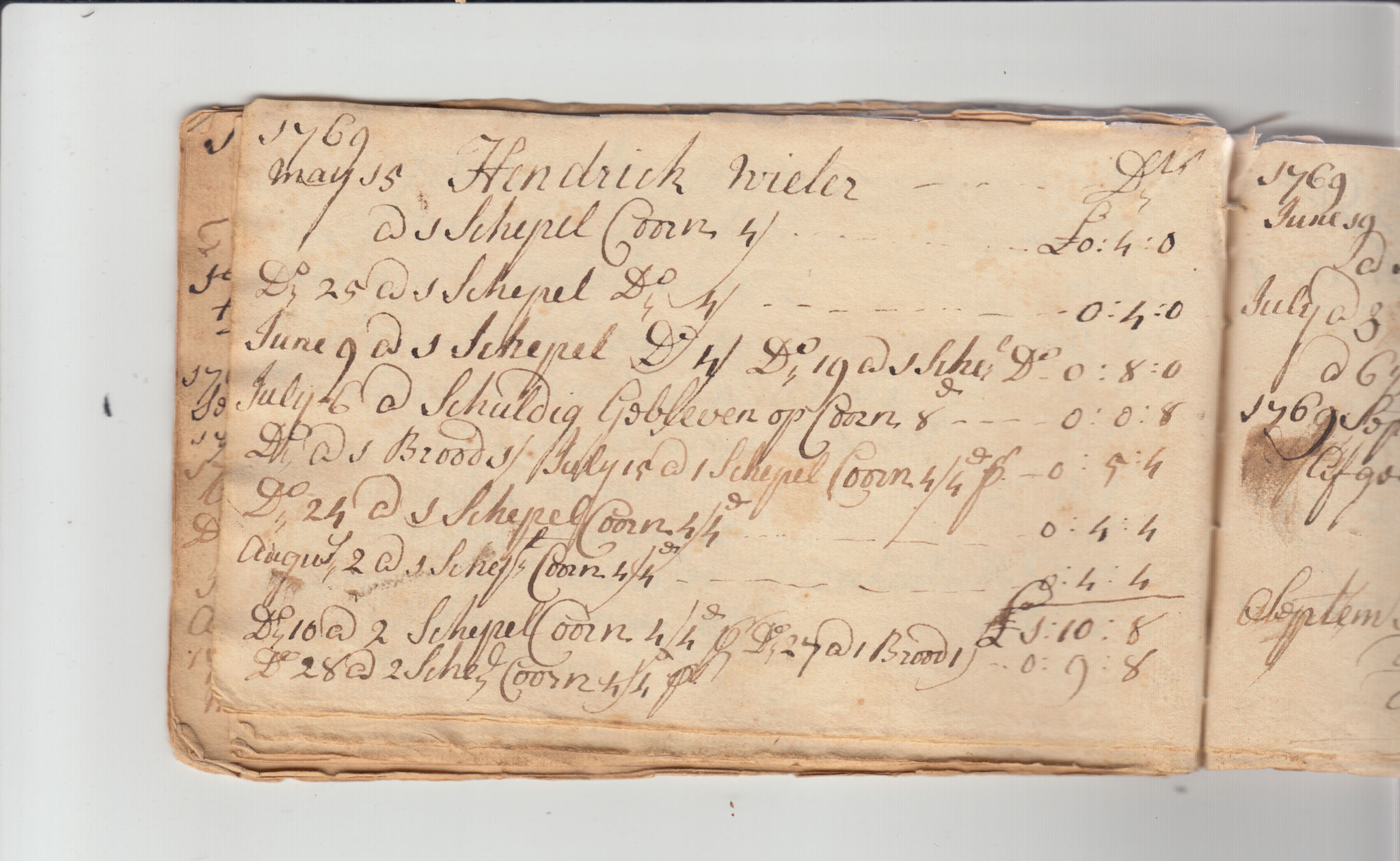
Image: BH105 Pg 28.jpg
Transcription
1769 May 15 Hendrick Wieler — Dr. @ 1 Schepel Coorn 4/ — £0:4:0 Do. 25 @ 1 Schepel Do. 4/ — 0:4:0 June 9 @ 1 Schepel Do. 4/ Do. 19 @ 1 Sche. Do. — 0:8:0 July 6 @ Schuldig Gebleven op Coorn 8 — 0:0:8 Do. @ 1 Brood 1/ July 15 @ 1 Schepel Coorn 4/4p — 0:4:4 Do. 24 @ 1 Schepel Coorn 4/4 — 0:4:4 Augus. 2 @ 1 Schep. Coorn 4/4 — 0:4:4 ————— £1:10:8 Do. 16 @ 2 Schepel Coorn 4/4 Do. 24 @ 1 Brood — 0:9:8 Do. 28 @ 2 Sche. Coorn 4/4p
Translation
1769 May 15 — Hendrick Wieler — Debtor 1 schepel corn at 4/ — £0:4:0 25th — 1 schepel corn at 4/ — 0:4:0 June 9 — 1 schepel corn at 4/; 19th — 1 schepel corn — 0:8:0 July 6 — remained indebted on corn 8d — 0:0:8 Same — 1 bread at 1/; July 15 — 1 schepel corn at 4s 4d — 0:4:4 24th — 1 schepel corn at 4s 4d — 0:4:4 August 2 — 1 schepel corn at 4s 4d — 0:4:4 ————— £1:10:8 16th — 2 schepels corn at 4s 4d; 24th — 1 bread — 0:9:8 28th — 2 schepels corn at 4s 4d
— Transcribed and translated by Claude.ai on 2026-05-02 - jhc
Commentary
Notes:
- Hendrick Wieler — a new name. Wieler is a Dutch/German surname meaning wheelwright, suggesting either an occupational origin or simply a family name. Not previously seen in the archive.
- Regular small corn purchases — buying 1-2 schepels at a time, consistently through May-August 1769, suggesting a household buying grain week by week rather than in bulk — a different pattern from the large Vosburgh purchases.
- Bread appearing twice — consistent with the occasional bread sales we’ve seen in the Clauw account, suggesting Jacobus or his household was baking commercially or at least selling surplus.
- Corn price rising — from 4/ to 4s 4d per schepel between May and July 1769, a seasonal price increase as winter stocks depleted.
- “Schuldig Gebleven op Corn 8” — “remained indebted on corn 8d” — a tiny carried balance from a previous transaction, meticulously recorded.
— Notes by Claude.ai 4.6 2026-05-02 - jhc
Page 29
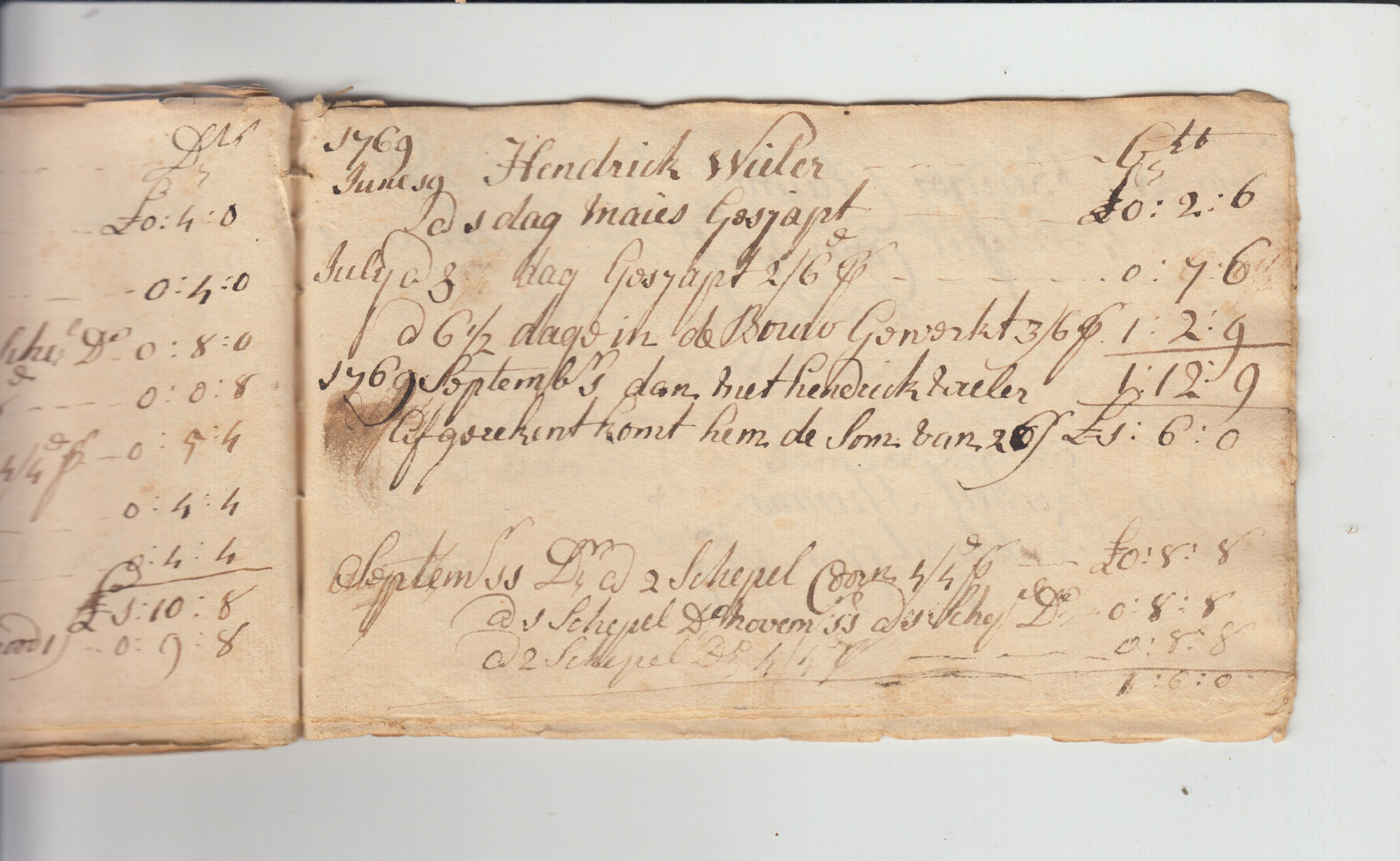
Image: BH105 Pg 29.jpg
Transcription
1769 Hendrick Wieler — Cr. June 9 @ 1 dag Maies Gesapt — £0:2:6 July @ 3 dag Gesapt 2/6p — 0:7:6 @ 6½ dags in de Boudo Gewerkt 3/6p — 1:2:9 ————— 1769 Septemb. 5 dan met Hendrick Wieler £1:12:9 Afgerekent komt hem de Som van 26/ £1:6:0 Septem. 11 Dr. @ 2 Schepel Coorn 4/4p — £0:8:8 @ 1 Schepel Do. Novem. 13 @ 1 Sche. Do. — 0:8:8 @ 2 Schepel Do. 4/4p — 0:8:8 Total: 1:6:0
Translation
1769 — Hendrick Wieler — Credit June 9 — 1 day sapping/collecting maize — £0:2:6 July — 3 days sapping at 2s 6d per day — 0:7:6 6½ days worked in the Boudo at 3s 6d — 1:2:9 ————— 1769, September 5 — then settled with Hendrick Wieler £1:12:9 settled, he is owed the sum of 26 shillings — £1:6:0 September 11 — Debtor: 2 schepels corn at 4s 4d — £0:8:8 1 schepel corn; November 13 — 1 schepel corn — 0:8:8 2 schepels corn at 4s 4d — 0:8:8 Total: 1:6:0
— Transcribed and translated by Claude.ai on 2026-05-02 - jhc
Commentary
Notes:
- “Maies Gesapt” — “maize sapped/collected” — harvesting or processing maize, at 2s 6d per day. The term sappen suggests extracting or collecting, possibly husking or processing corn.
- “in de Boudo Gewerkt” — “worked in the Boudo” — the same mysterious “Boudo” location we saw in the Gardenier labor entry on page 21 — “de Bous Gobondo”. Here it appears more clearly as simply “de Boudo” — likely a specific field, barn, or area on the Huyck property with a local name.
- Settlement favors Wieler — unusually, after netting debts and credits, Jacobus owes Wieler 26 shillings — £1:6:0. Wieler’s labor credits exceeded his corn purchases.
- Immediately a new debit account opens September 11 — Wieler resuming corn purchases right after settlement, the cycle continuing.
- The labor rate of 3s 6d per day for “Boudo” work versus 2s 6d for maize collecting suggests different skill or effort levels for different farm tasks.
— Notes by Claude.ai 4.6 2026-05-02 - jhc
Page 30
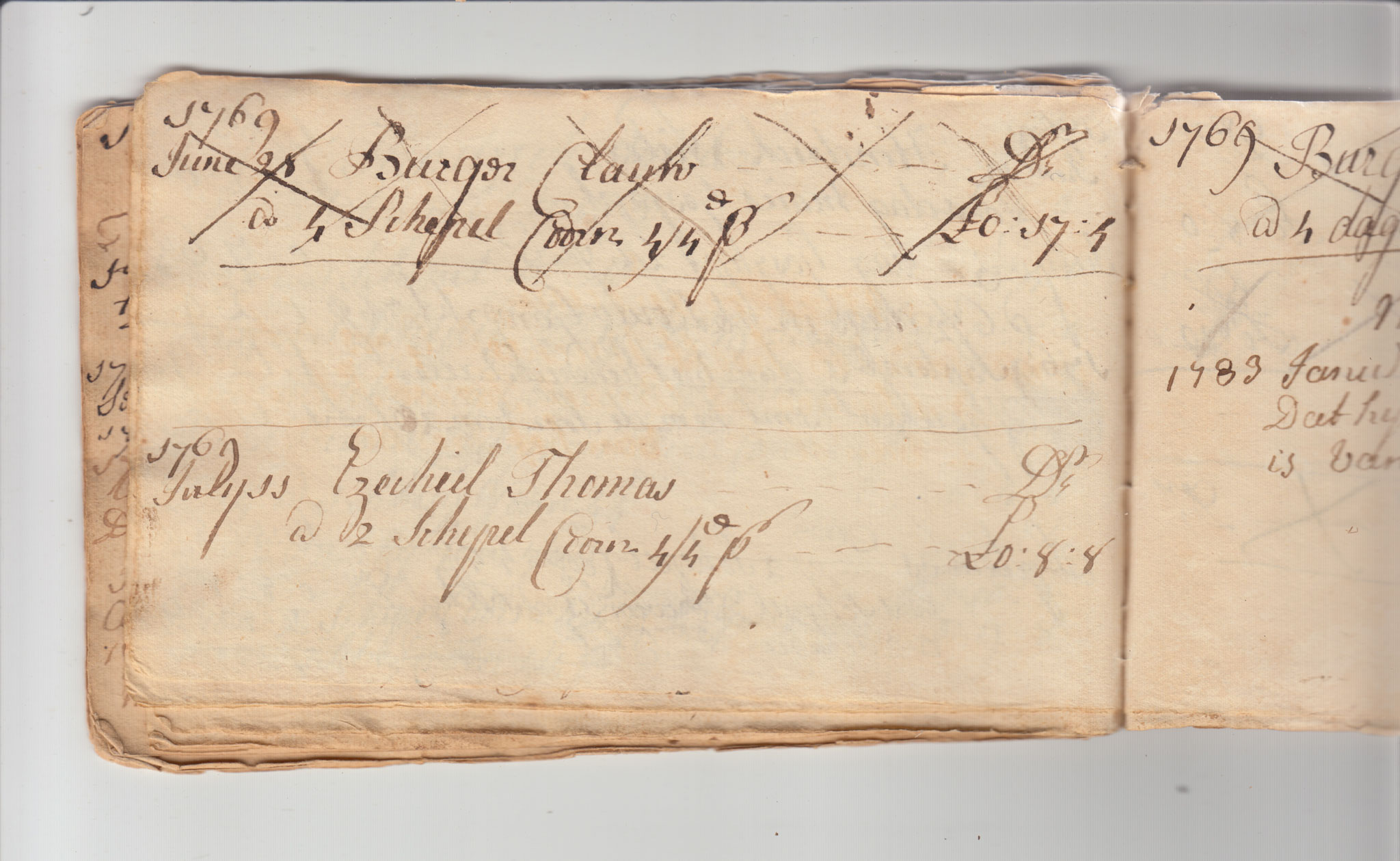
Image: BH105 Pg 30.jpg
Transcription
1769 June 28 Burger Clauw — Dr. @ 4 Schepel Coorn 4/4p — £0:17:4 [crossed out — settled] —————————— 1769 July 15 Ezechiel Thomas — Dr. @ ½ Schepel Corn 4/4p — £0:4:4
Translation
1769 June 28 — Burger Clauw — Debtor 4 schepels corn at 4s 4d — £0:17:4 [settled] —————————— 1769 July 15 — Ezechiel Thomas — Debtor ½ schepel corn at 4s 4d — £0:4:4
— Transcribed and translated by Claude.ai on 2026-05-02 - jhc
Commentary
Notes:
- Burger Clauw — a new member of the Clauw family, distinct from Willem Clauw whose account dominated the first half of the book. Possibly Willem’s son or brother. A single transaction, quickly settled.
- Ezechiel Thomas — a striking name, entirely new to the archive. Ezechiel is a Biblical name more common among New England Puritan families than among Dutch Hudson Valley settlers, suggesting Thomas may be of New England origin — consistent with the eastward demographic mixing in Columbia County by the late 1760s. Benjamin Thomas appears in the 1744 Kinderhook tax list, possibly a relative.
- A very small purchase — just ½ schepel of corn — suggesting either a casual neighbor transaction or the beginning of what may be a larger account continuing on the next page.
- The account is not cancelled — likely continuing.
— Notes by Claude.ai 4.6 2026-05-02 - jhc
Metadata
Document: BH105_Pg_21-30
Date: 1768-1769
Language: Dutch
Type: Account, Ledger
Subject: Commerce, Agriculture
Principals: Jacob Hend. Gardenier, Hendrick Gardenier Jr., Adriaen Quackenbush, Johannis Rous, James Goolden, James de Goljor, Hendrick Wieler, Burger Clauw, Ezechiel Thomas
Places Mentioned: None
Persons Mentioned in the Ledger, with page links
- Clauw, Burger ~ pg 30, 31
- Clauw, Hendrick ~ pg 38
- Clauw, Johannis ~ pg 32
- Clauw, Willem ~ pg 2, 3, 6, 7, 8, 9, 16, 17, 19
- de Goljor, James ~ pg 24, 25, 26
- Ducolon, Claude ~ pg 20
- Gardenier, Jacob Hend. ~ pg 21
- Goes, Michiel ~ pg 31
- Goolden, James ~ pg 24
- Huyck, Andries Johs. ~ pg 32
- Huyck, Arent ~ pg 37
- Huyck, Burger Jr. ~ pg 1, 10, 11
- Huyck, Burger, son of Jacobus ~ pg 37
- Huyck, Elizabeth ~ pg 44
- Huyck, Jacobus ~ pg 37
- Huyck, Johannis ~ pg 4, 5, 13
- Huyck, Margarette ~ pg 44
- Quackenbush, Adriaen ~ pg 22
- Rous, Johannis ~ pg 23
- Thomas, Ezechiel ~ pg 30
- Van den Berg, Willem ~ pg 18
- Valkenburgh, Johannis Johs. ~ pg 36, 37
- Vosburgh, Marten ~ pg 34, 35
- Vosburgh, Peter ~ pg 12, 14
- Wieler, Hendrick ~ pg 28, 29, 32
— page revised 2026-06-02 - jhc
< Next Earlier Document — Next Later Document >
Huyck Bain Crandell Collection © 2026 by John H. Coxon is licensed under CC BY-NC-SA 4.0


