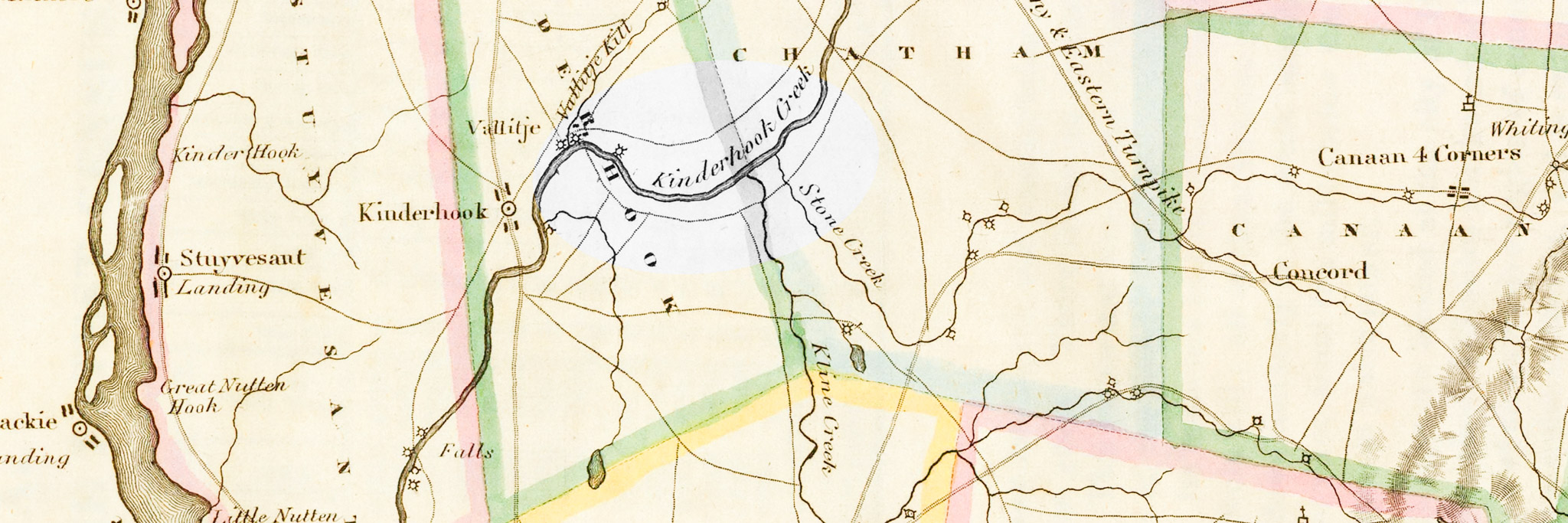
The Huyck Bain Crandell Collection, Document BH105_Pg_31-44
< Next Earlier Document — Next Later Document >
1759-1771 & 1783 - Farm Sales Account Book - Pages 31-44
This is pages 31 through 44 from a farm sales account book or ledger of 44 pages I think belonging to Jacobus Huyck. A few blank pages are not recorded here. jhc
- Pages 1-10
- Pages 11-20
- Pages 21-30
- Page 31 ~ Burger Clauw, Michiel Goes, debtors
- Page 32 ~ Andries Johannis Huyck, Johannis Clauw, Hendrick Wieler, debtors
- Page 33 ~ Blank
- Page 34 ~ Marten Vosburgh, debtor
- Page 35 ~ Marten Vosburgh, debtor
- Page 36 ~ Johannis Johs. V Valkenburgh, debtor
- Page 37 ~ Johannis Johs. V Valkenburgh, creditor
- Page 38 ~ Hendrick Clauw, laborer
- Page 39 ~ Blank
- Page 40 ~ Blank
- Page 41 ~ Blank
- Page 42 ~ Blank
- Page 43 ~ Calculation scratch sheet
- Page 44 ~ Calculation scratch sheet, Elizabeth Huyck, Margarette Huyck
See list of Persons Mentioned in the Ledger, with page links.
Page 31
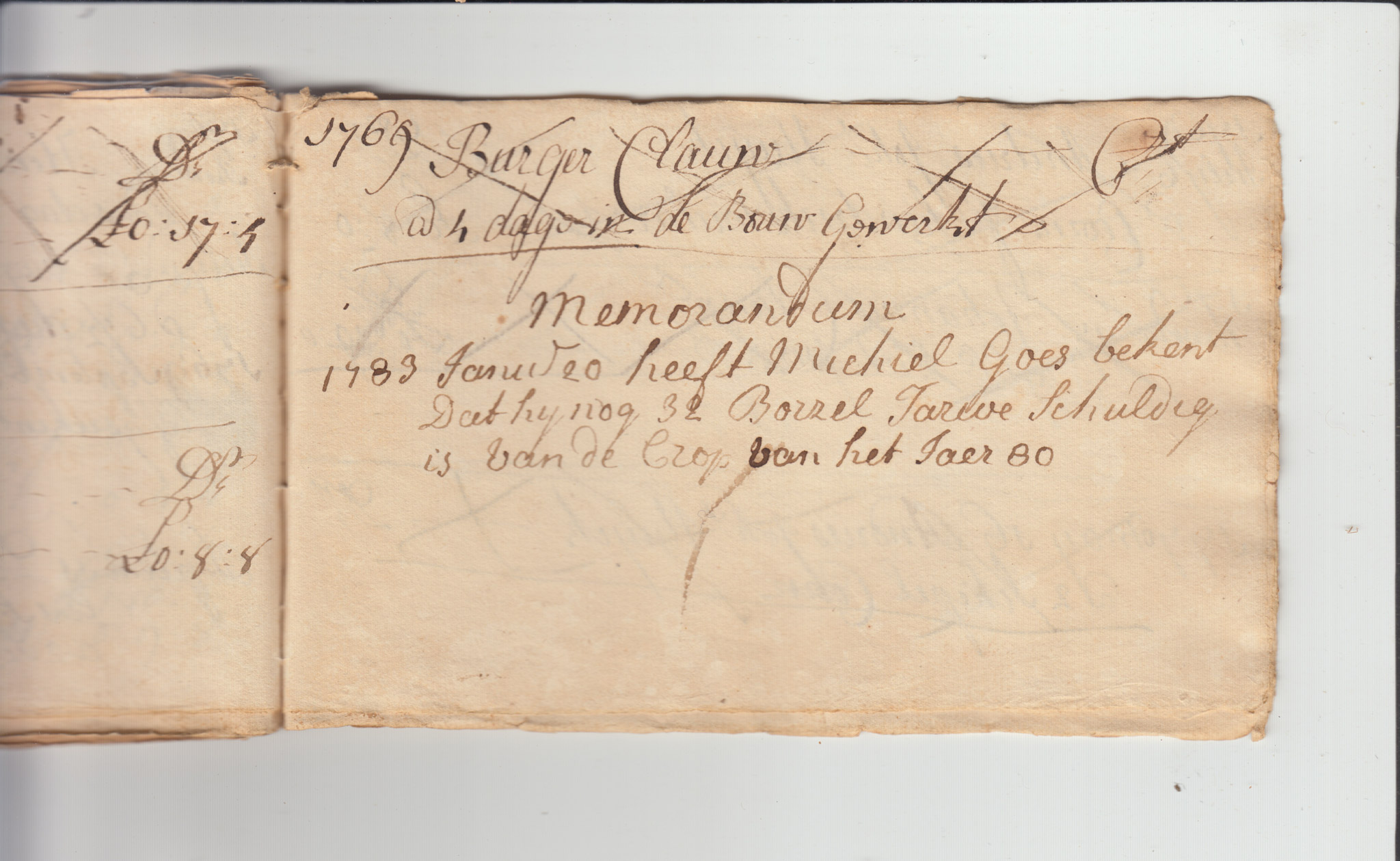
Image: BH105 Pg 31.jpg
Transcription
1769 Burger Clauw — Cr. @ 4 dags in de Bouw Gewerkt [crossed out — settled] —————————— Memorandum 1783 Janu. 20 heeft Michiel Goes bekent Dat hy nog 32 Borrel Tarwe Schuldig is van de Crop van het Jaer 80
Translation
1769 — Burger Clauw — Credit 4 days worked in the Bouw [farm/field] [settled] —————————— Memorandum 1783, January 20 — Michiel Goes has acknowledged that he still owes 32 bushels of wheat from the crop of the year 1780
— Transcribed and translated by Claude.ai on 2026-05-02 - jhc
Commentary
Notes:
- Burger Clauw’s credit — 4 days farm labor offsetting his corn purchase from page 30, quickly settled. The “Bouw” — farm/field — appears here as a generic term rather than the specific “Boudo” location name we’ve seen elsewhere.
- The memorandum is extraordinary — a jump of fourteen years from 1769 to 1783, written in the same book. This is the first document in the account book that clearly post-dates the main run of accounts, suggesting the book was kept and referred to long after its primary use ended.
- 1783 — the Revolutionary War has just ended. The world of colonial Albany County Dutch commerce that this book documents has been fundamentally transformed.
- Michiel Goes — the Goes family was one of the most prominent Dutch families in Kinderhook, with multiple members in the 1744 tax list — Lucas Goes, Hans Goes, Johan Goes, Margareta Goes, Matt Goes Jr., Peter Goes. Michiel Goes acknowledging a debt from 1780 — the height of the Revolutionary War — suggests grain obligations that went unsettled during the disruption of the war years.
- 32 bushels of wheat — tarwe — from the 1780 crop, still unresolved in January 1783. A significant quantity, suggesting a sharecropping or crop-sharing arrangement rather than a simple sale.
- “van de Crop van het Jaer 80” — “from the crop of the year 1780” — the phrasing implies Goes was farming Huyck land and owed a share of the wheat harvest, a tenant farming arrangement that would be entirely consistent with the Huyck patent landholdings.
- This single memorandum opens an entirely new chapter — the Huyck family navigating the Revolutionary period and its aftermath.
— Notes by Claude.ai 4.6 2026-05-02 - jhc
Page 32
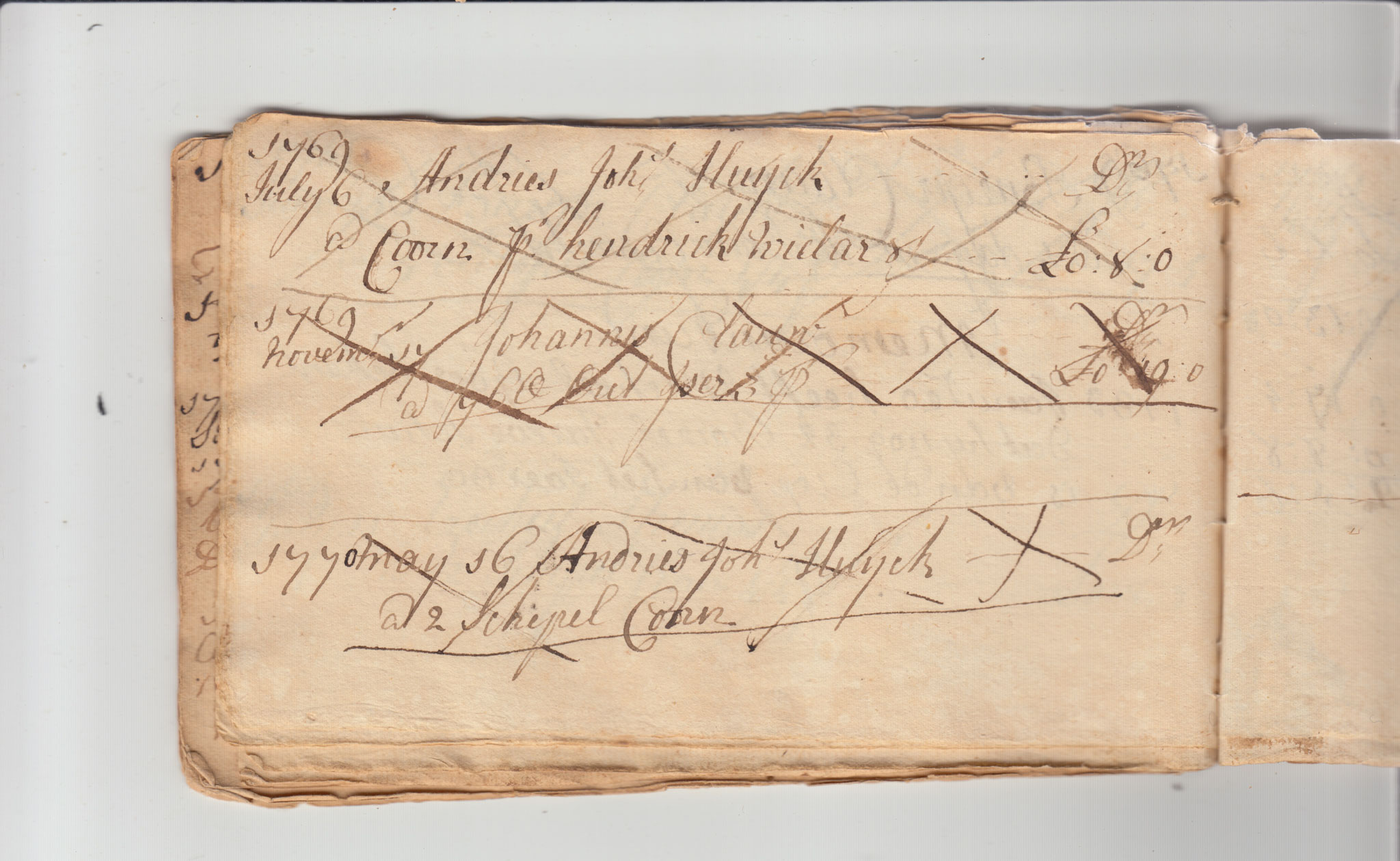
Image: BH105 Pg 32.jpg
Transcription
1769 July 6 Andries Johs. Huyck — Dr. @ Coorn p Hendrick Wieler 4/ — £0:8:0 [crossed out — settled] —————————— 1769 Novem. 14 Johannis Clauw — Dr. 7 lb Oud Spek p — £0:10:0 [crossed out — settled] —————————— 1770 May 16 Andries Johs. Huyck — Dr. 2 Schepel Coorn [crossed out — settled]
Translation
1769 July 6 — Andries Johs. Huyck — Debtor corn via/through Hendrick Wieler at 4/ — £0:8:0 [settled] —————————— 1769 November 14 — Johannis Clauw — Debtor 7 pounds old/cured pork at [?] — £0:10:0 [settled] —————————— 1770, May 16 — Andries Johs. Huyck — Debtor 2 schepels corn [settled]
— Transcribed and translated by Claude.ai on 2026-05-02 - jhc
Commentary
Notes:
- Andries Johs. Huyck — Andries Johannis Huyck, son of Johannis Huyck — a fourth generation now appearing in the account book. His father Johannis was chronically indebted to Jacobus throughout the 1760s; now Johannis’s son is buying corn from his great-uncle Jacobus in 1769-1770.
- “@ Corn p Hendrick Wieler” — the corn was delivered via or through Hendrick Wieler — confirming Wieler’s role as a local intermediary or neighbor who handled deliveries between the Huyck properties.
- Johannis Clauw — yet another Clauw family member, distinct from Willem Clauw and Burger Clauw. The Clauw family’s commercial relationship with the Huycks spans the entire account book across multiple family members.
- “Oud Spek” — old/cured pork, distinguished from the fresh smoked bacon (Rook Spek) sold to Willem Clauw — suggesting different stages of pork curing and preservation.
— Notes by Claude.ai 4.6 2026-05-02 - jhc
Page 33
Page 33 is blank and omitted here. jhc
Page 34
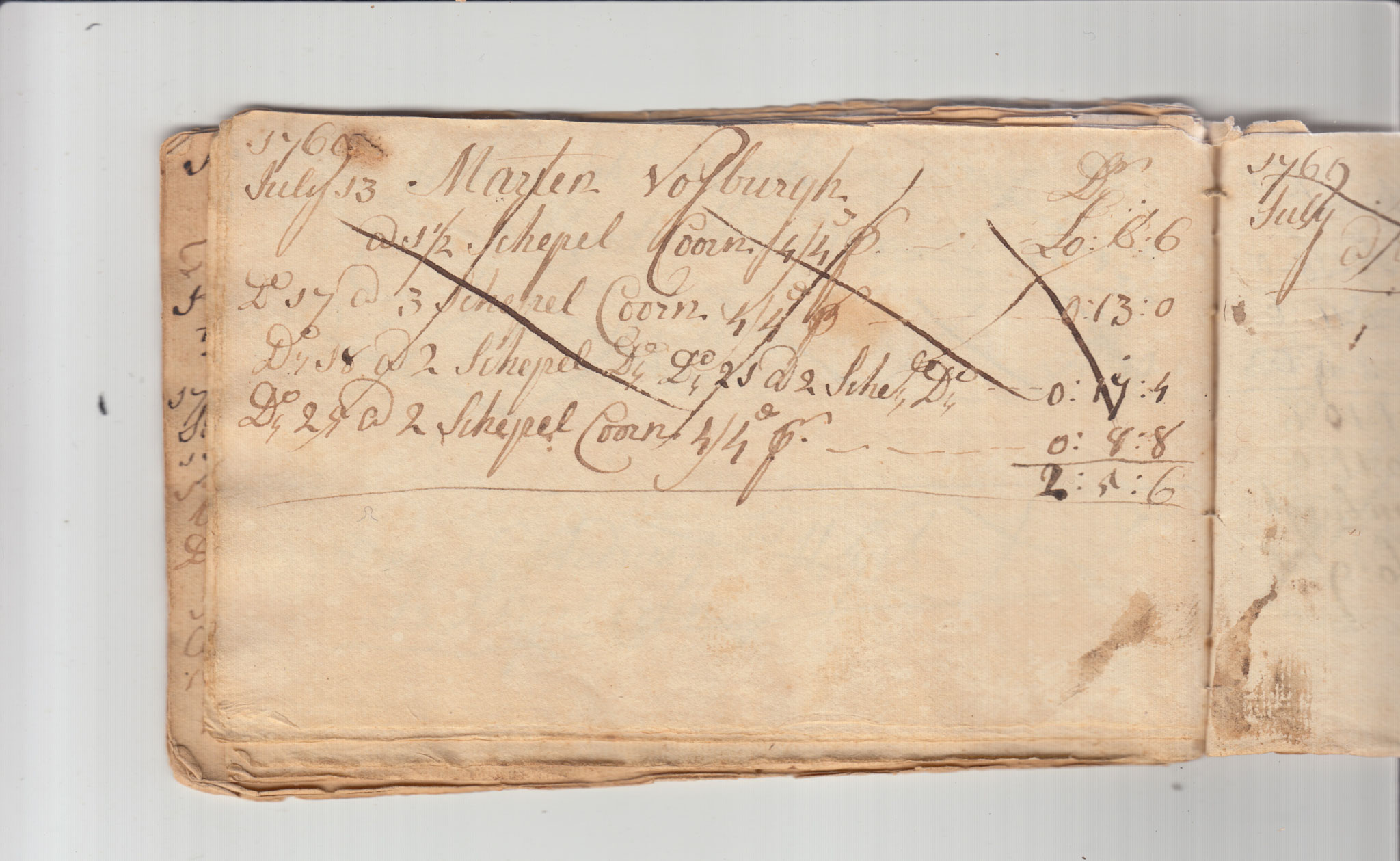
Image: BH105 Pg 34.jpg
Transcription
1769 July 13 Marten Vosburgh — Dr. a 1½ Schepel Coorn 4/4p — £0:6:6 Do. 17 a 3 Schepel Coorn 4/4p — 0:13:0 Do. 18 a 2 Schepel Do. Do. 25 a 2 Sche. Do. — 0:17:4 Do. 29 a 2 Schepel Coorn 4/4p — 0:8:8 ————— 2:5:6 [large X cancellation — settled]
Translation
1769 July 13 — Marten Vosburgh — Debtor 1½ schepels corn at 4s 4d — £0:6:6 17th — 3 schepels corn at 4s 4d — 0:13:0 18th — 2 schepels corn; 25th — 2 schepels corn — 0:17:4 29th — 2 schepels corn at 4s 4d — 0:8:8 ————— Total: £2:5:6 [settled]
— Transcribed and translated by Claude.ai on 2026-05-02 - jhc
Commentary
Notes:
- Marten Vosburgh — another member of the Vosburgh family, distinct from Peter Vosburgh who appeared earlier. The Vosburghs were one of the patent partner families and clearly maintained a long commercial relationship with the Huycks across generations.
- Intensive corn buying — purchasing corn on July 13, 17, 18, 25, and 29 — nearly every few days over two weeks — suggesting either a pressing need or regular provisioning of a mill or livestock operation.
- 10½ schepels in two weeks — a substantial quantity purchased very rapidly, consistent with the large Vosburgh corn purchases we saw on page 14.
- The account is fully cancelled — promptly settled, consistent with Peter Vosburgh’s pattern of reliable payment.
- The lower half of the page is blank — suggesting this may be near the end of the account book’s active use in 1769-1770.
— Notes by Claude.ai 4.6 2026-05-02 - jhc
Page 35
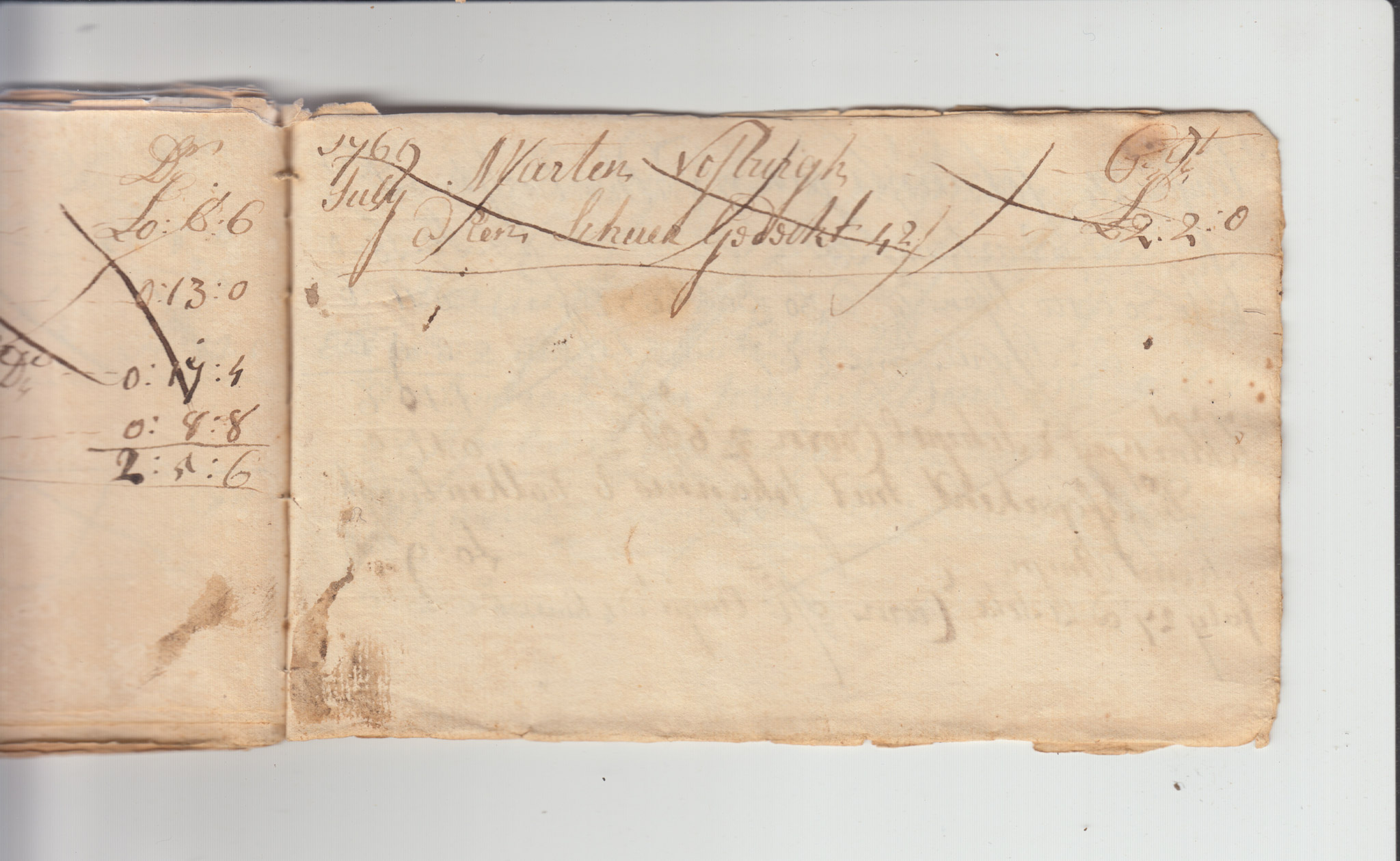
Image: BH105 Pg 35.jpg
Transcription
1769 Marten Vosburgh — Cr. July — Corn Schuld Gesakt 42/ — £2:2:0 [crossed out — settled]
Translation
1769 — Marten Vosburgh — Credit July — corn debt settled/sacked at 42 shillings — £2:2:0 [settled]
— Transcribed and translated by Claude.ai on 2026-05-02 - jhc
Commentary
Notes:
- “Corn Schuld Gesakt” — “corn debt settled/sacked” — an interesting phrase. Gesakt could mean the corn debt was settled in sacked/bagged corn — i.e., Vosburgh paid his debt by delivering bagged corn back to Jacobus, an in-kind payment consistent with what we’ve seen throughout the book.
- £2:2:0 — exactly matching the total from page 34, confirming full settlement.
— Notes by Claude.ai 4.6 2026-05-02 - jhc
Page 36
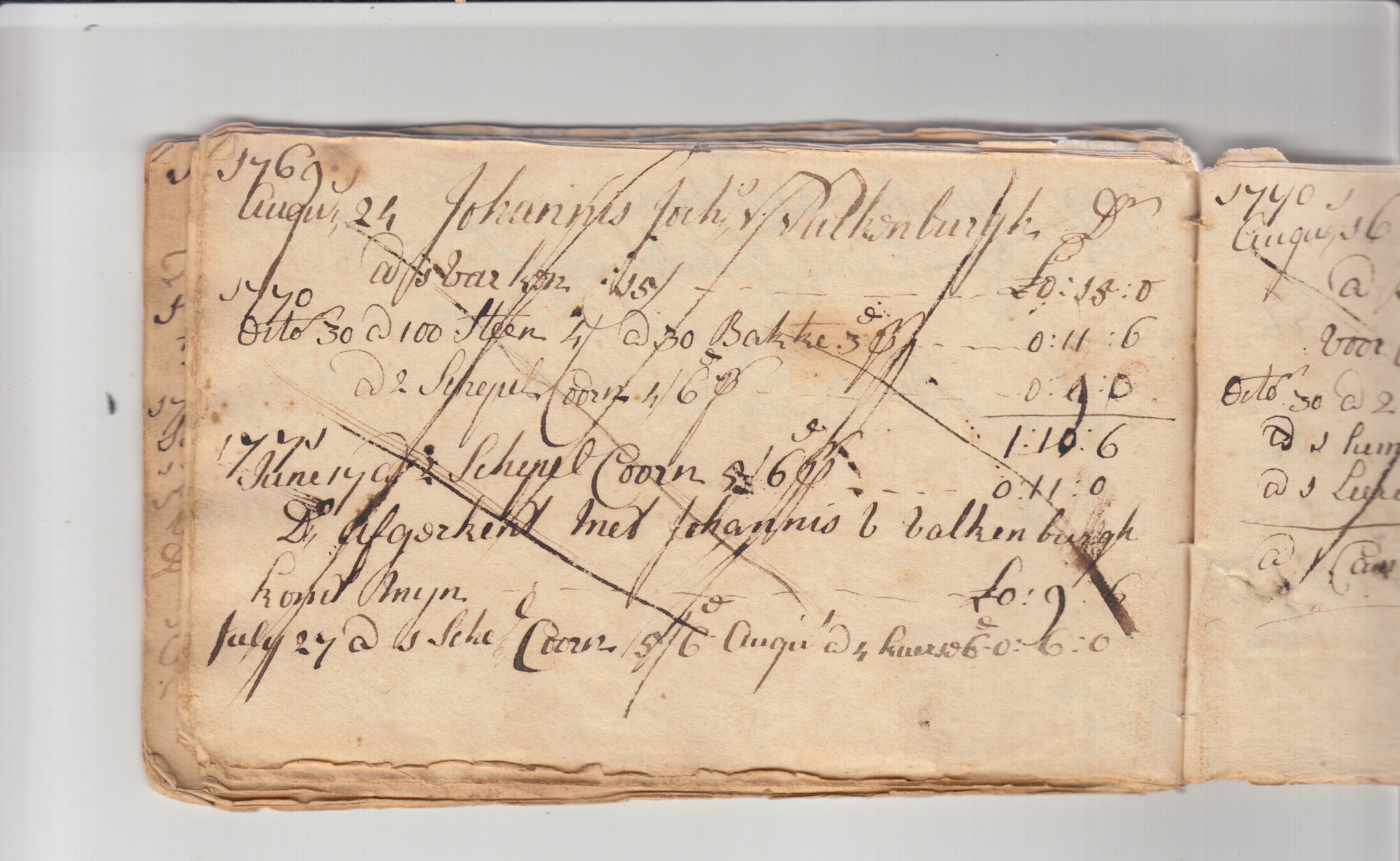
Image: BH105 Pg 36.jpg
Transcription
1769 Augus. 24 Johannis Johs. Valkenburgh — Dr. a ½ Barkem 15/ — £0:15:0 1770 Octo. 30 a 100 Steen 1/ @ 30 Bakke 3/p — 0:11:6 @ 2 Schepel Corn 4/6p — 0:9:0 ————— [subtotal] 1:10:6 1771 June 19 @ 2 Schepel Coorn 5/6p — 0:11:0 Do. Afgerekent met Johannis V Valkenburgh komt myn — £0:9:6 July 27 @ 16 Sche. Coorn 15/6 Augus. @ 4 kaer06 — 0:6:0 [crossed out]
Translation
1769 August 24 — Johannis Johs. V Valkenburgh — Debtor ½ barrel [cider/spirits?] at 15/ — £0:15:0 1770 October 30 — 100 stones at 1/; 30 bricks at 3/ — 0:11:6 2 schepels corn at 4s 6d — 0:9:0 ————— [subtotal 1:10:6 — settled] 1771 June 19 — 2 schepels corn at 5s 6d — 0:11:0 Same — settled with Johannis V Valkenburgh comes to me — £0:9:6 July 27 — 16 schepels corn at 15s 6d; August @ 4 — [?] — 0:6:0 [settled]
— Transcribed and translated by Claude.ai on 2026-05-02 - jhc
Commentary
Notes:
- Johannis Johs. Valkenburgh — the Van Valkenburgh family was one of the most prominent in Kinderhook, with multiple entries in the 1744 tax list. “Johs.” indicates his father was also Johannis — Johannis Johannissen Van Valkenburgh.
- 100 stones and 30 bricks — construction materials, connecting to the stone-related transactions we’ve seen with Goljer and Johannis Huyck. Building activity on the Huyck property continuing into 1770.
- 16 schepels corn in a single July transaction — a large purchase suggesting either a mill connection or livestock feed needs similar to the Vosburgh pattern.
- Corn price rising — from 4s 6d in 1770 to 5s 6d in 1771, a significant increase possibly reflecting poor harvests.
- The account now extends into 1771 — the latest date we’ve seen in the main account book, aside from the 1783 memorandum.
— Notes by Claude.ai 4.6 2026-05-02 - jhc
Page 37
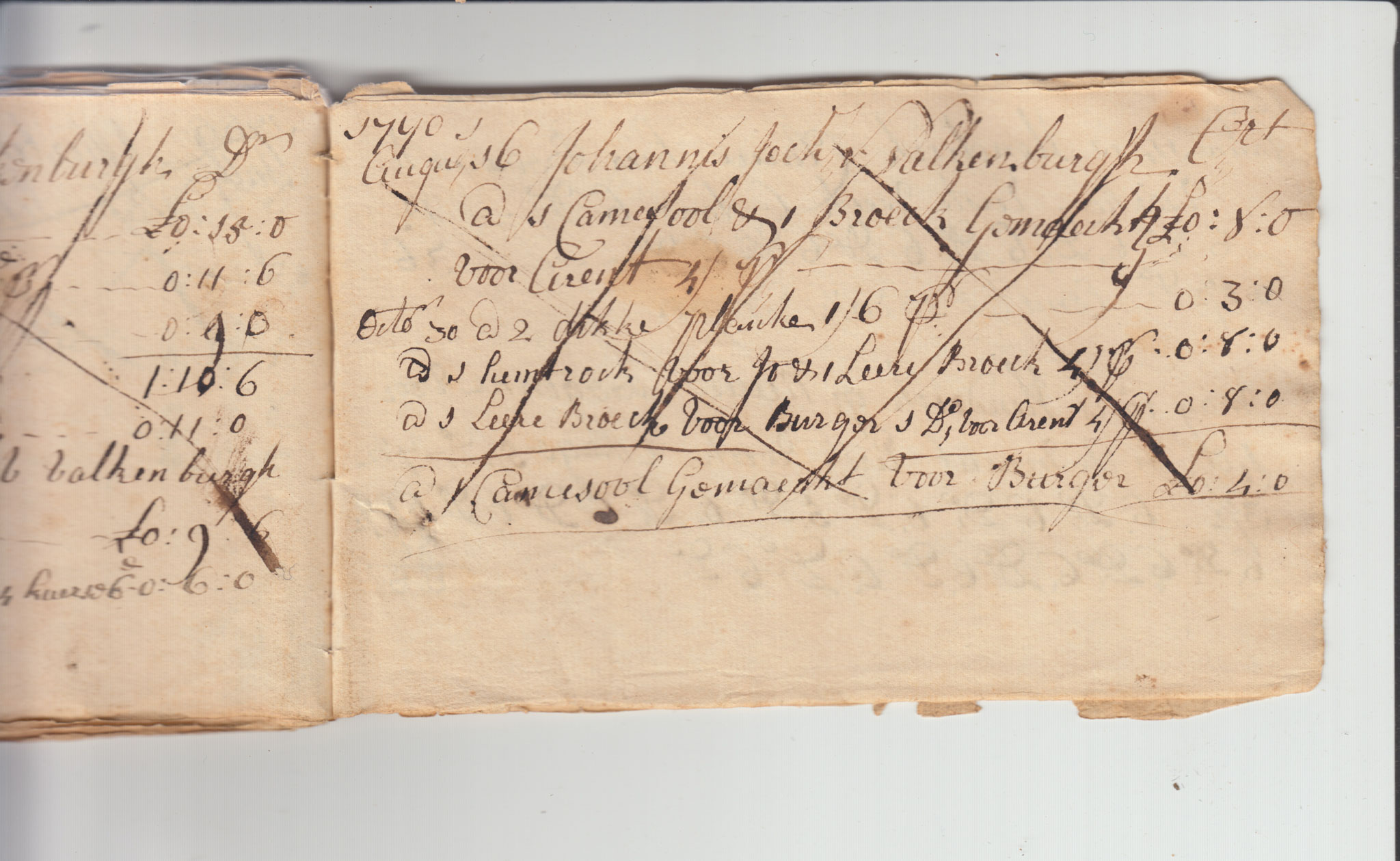
Image: BH105 Pg 37.jpg
Transcription
1770 Augus. 16 Johannis Johs. V Valkenburgh — Cr. @ 1 Camesool & 1 Broeck Gemacht 4/0 — £0:8:0 voor Credit 4/p — [?] Octo. 30 a 2 dikke Planke 1/6p — 0:3:0 @ 1 Hemtrock voor Jo & 1 Leere Broeck 4/p — 0:8:0 @ 1 Leere Broeck voor Burger 1 Do. voor Arent 4/p — 0:8:0 @ 1 Camesool Gemacht voor Burger — £0:4:0
[crossed out]
Translation
1770 August 16 — Johannis Johs. V Valkenburgh — Credit 1 waistcoat & 1 pair trousers made at 4/ — £0:8:0 for credit at 4/ — [?] October 30 — 2 thick planks at 1s 6d — 0:3:0 1 shirt/smock for Jo & 1 leather breeches at 4/ — 0:8:0 1 leather breeches for Burger; 1 same for Arent at 4/ — 0:8:0 1 waistcoat made for Burger — £0:4:0 [settled]
— Transcribed and translated by Claude.ai on 2026-05-02 - jhc
Commentary
Notes:
- Valkenburgh was a tailor or leatherworker — this credit page reveals his trade entirely. He is paying his corn and stone debt by making clothing for the Huyck family — waistcoats (camesool), trousers (broeck), shirts/smocks (hemtrock), and leather breeches (leere broeck).
- Named family members — clothing made specifically for Jo (Johannis/Jacobus?), Burger (Burger Jr.), and Arent — three Huyck family members named in a single entry, giving us the most direct glimpse of the family’s daily life in the entire account book.
- “dikke Planke” — thick planks, suggesting Valkenburgh also supplied timber or lumber in addition to tailoring services.
- Leather breeches — a practical working garment for farm life, made in multiples for different family members.
- The tailoring credits are a wonderful detail — the Huyck family’s clothing being made by a neighbor working off his corn debt, a perfect encapsulation of the barter economy this account book documents throughout.
— Notes by Claude.ai 4.6 2026-05-02 - jhc
Page 38
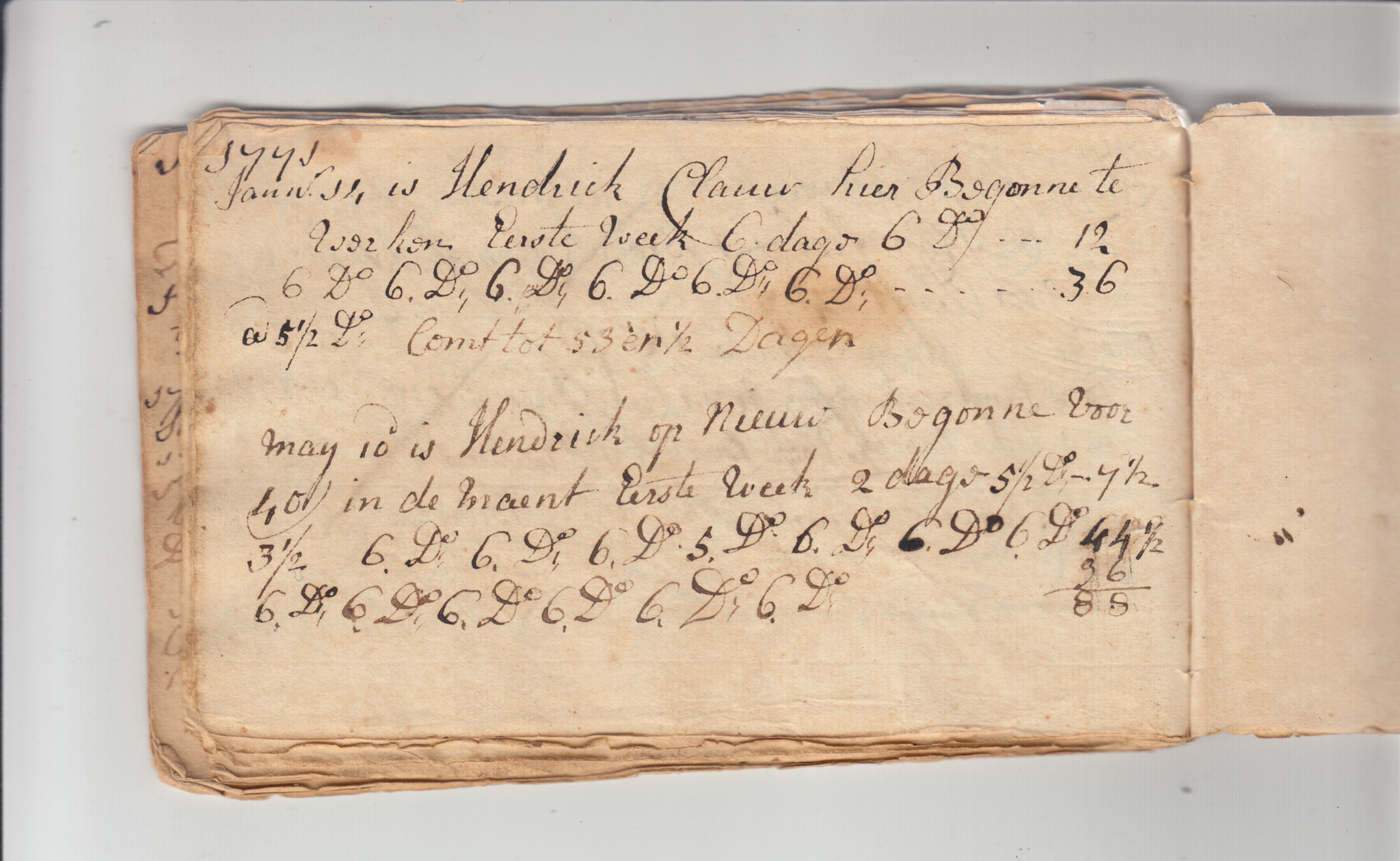
Image: BH105 Pg 38.jpg
Transcription
1771 Janu. 11 is Hendrick Clauw hier Begonne te Werken Eerste Week 6 dags 6 Do — 12 6 Do 6 Do 6 Do 6 Do 6 Do 6 Do — 36 @ 5½ Do Comt tot 53 en ½ Dagen May 10 is Hendrick op Nieuw Begonne voor 40/ in de Maent Eerste Week 2 dags 5½ Do — 7½ 3½ 6 Do 6 Do 6 Do 5 Do 6 Do 6 Do 6 Do 44½ 6 Do 6 Do 6 Do 6 Do 6 Do 6 Do — 36 ————— 88
Translation
1771 January 11 — Hendrick Clauw began working here First week 6 days; 6 days [repeated] — 12 6 days, 6 days, 6 days, 6 days, 6 days, 6 days — 36 and 5½ days — comes to 53½ days total May 10 — Hendrick began anew for 40 shillings per month — First week 2 days; 5½ days — 7½ 3½; 6, 6, 6, 5, 6, 6, 6 days — 44½ 6, 6, 6, 6, 6, 6 days — 36 ————— Total: 88 days
— Transcribed and translated by Claude.ai on 2026-05-02 - jhc
Commentary
Notes:
- A hired laborer’s time sheet — completely different in format from the commodity accounts we’ve seen throughout the book. This is a running tally of days worked rather than goods exchanged.
- Hendrick Clauw — yet another member of the prolific Clauw family, now working as a hired hand on the Huyck farm. The family that has been buying corn and other goods from Jacobus throughout the 1760s is now also providing farm labor.
- 53½ days in the first period (January-May 1771) — nearly nine weeks of consecutive daily work, suggesting a full-time farm laborer.
- 40 shillings per month — the second period has a fixed monthly wage rather than a day rate, a slightly more formal employment arrangement. At 40/ per month this is roughly 16d per day — consistent with agricultural wages of the period.
- 88 days in the second period — nearly fifteen weeks from May onward.
- The format of recording individual daily tallies — 6, 6, 6, 5½ etc. — is a meticulous time-keeping record, suggesting Jacobus was careful to track every day of labor precisely.
- This is the most sustained labor record in the book, and the latest dated entry in the main accounts — 1771 — suggesting this is near the end of the book’s active use before the 1783 memorandum.
— Notes by Claude.ai 4.6 2026-05-02 - jhc
Pages 39 through 42
Pages 39 through 42 are blank and omitted here. jhc
Page 43
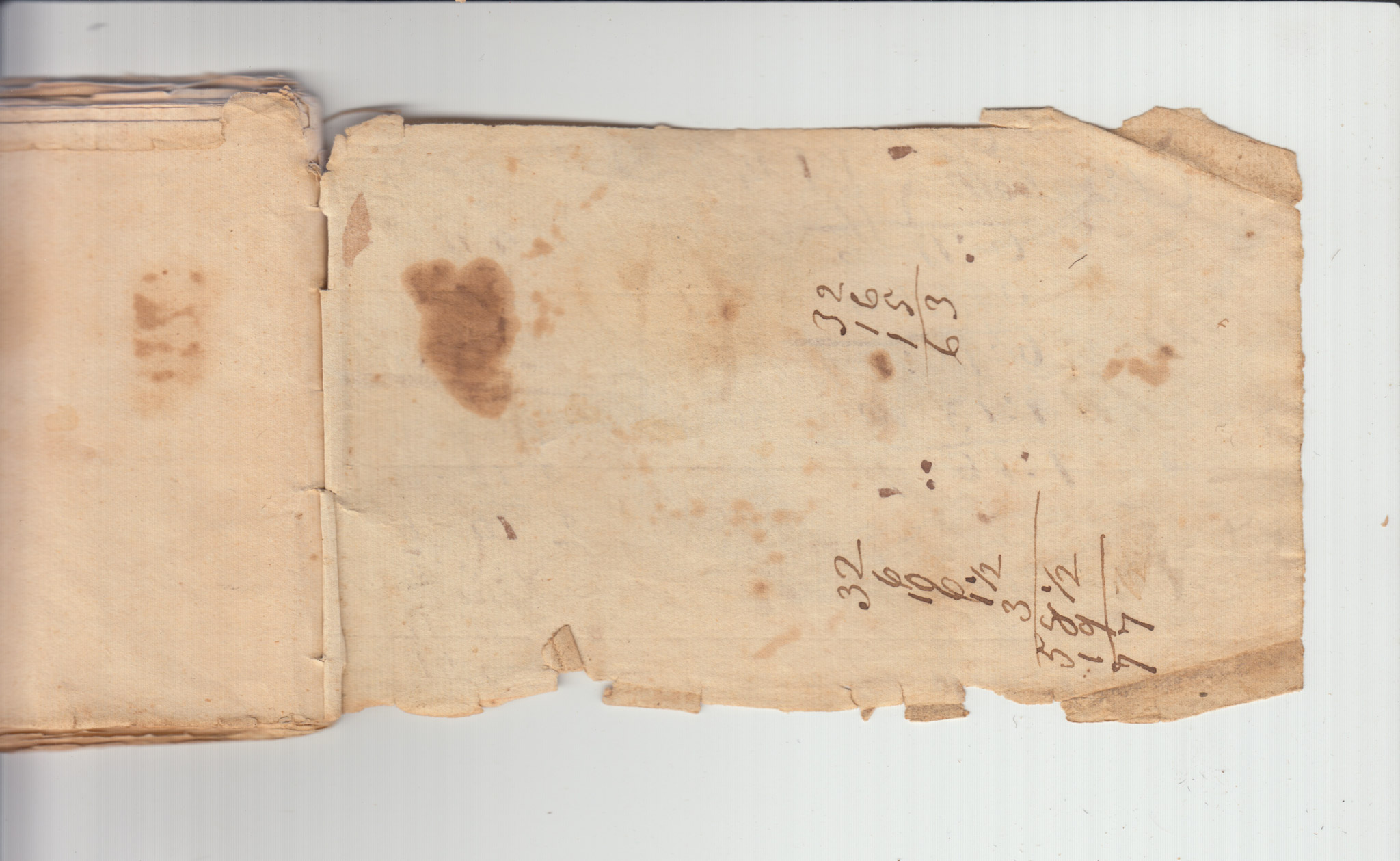
Image: BH105 Pg 43.jpg
Transcription
32 16 15 Total 63
32 6 10 6 1-1/2 3 Total 58-1/2 19 Total 77
— Transcribed by Claude.ai on 2026-05-02 - jhc
Commentary
Notes:
- This appears to be the inside back cover of the account book, used for rough arithmetic — the kind of quick calculations a bookkeeper would scratch down while working through accounts. The numbers don’t resolve into a clear final statement.
- The wear and staining on this page — particularly the large water or organic stain on the left — is consistent with a back cover that has protected the book’s contents for over two centuries.
— Notes by Claude.ai 4.6 2026-05-02 - jhc
Page 44
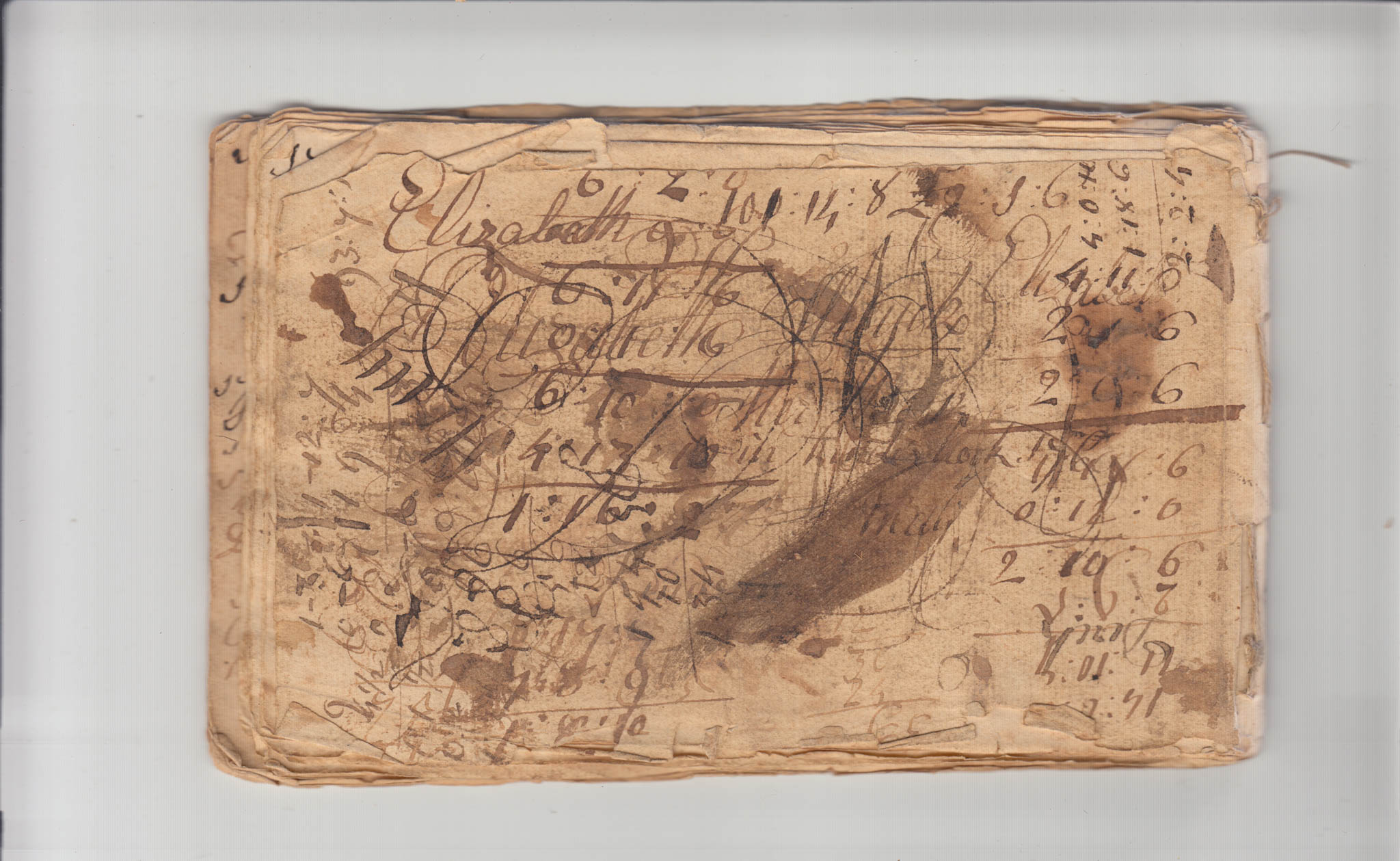
Image: BH105 Pg 44.jpg
Transcription
This is the back cover of the account book — heavily used as a scratch pad for calculations, with multiple layers of writing, water damage, and ink bleed making it nearly impossible to read systematically. What I can make out:
- “Elizabeth” — a name, upper left, fairly clearly written
- “Margarette Huyck” — mid-left, also reasonably legible — a female Huyck family member not previously named in the book
- “Kinderhook” — appears mid-right
- “May” — lower center
- Columns of figures down the right margin — sums in pounds, shillings, pence format
The rest is a palimpsest of overlapping calculations, cross-outs, ink stains and water damage that defeats systematic transcription. The cover was clearly used over an extended period for rough arithmetic — the kind of working surface that accumulates years of quick calculations.
— Transcribed by Claude.ai on 2026-05-02 - jhc
Commentary
Notes:
Elizabeth and Margarette Huyck are the significant finds here — two female family members named for the first time in the archive. Elizabeth Huyck is Jacobus’s wife; she has been invisible in the commercial record until this final page.
— Notes by Claude.ai 4.6 2026-05-02 - jhc
Taking stock of the account book as a whole
The book runs from 1759 to 1783 — with the main accounts concentrated in 1759-1771 and a single memorandum in 1783. It was kept by Jacobus Huyck and documents his commercial relationships with roughly twenty individuals and families.
The trading partners and their relationships:
- Willem Clauw — eleven years, the dominant account, chronic debtor, paying in butter, bacon, wool, and occasional labor
- Johannis Huyck — Jacobus’s brother, nearly a decade of grain advances, never fully settling
- Peter Vosburgh — annual large corn purchases, prompt payer, likely a miller
- Burger Huyck Jr. — another brother, smaller accounts, settled regularly
- James de Goljer — mason, paying in stone breaking and oven construction
- Johannis Van Valkenburgh — tailor/leatherworker, paying in clothing for the family
- Hendrick Wieler — small corn purchases, paying in farm labor
- Hendrick Clauw — hired laborer, 141+ days recorded
- Fraens Pruijn — blacksmith supplying farm implements
- Michiel Goes — tenant farmer, wheat from the 1780 crop
- Plus shorter accounts with Marten Vosburgh, Jacob Gardenier, Adriaen Quackenbush, Johannis Rous, James Goolden, Claude Ducolon, Willem Van den Berg, Burger Clauw, Johannis Clauw, Ezechiel Thomas, and Andries Johs. Huyck
The commodities traded
Corn, rye, oats, maize, wheat, flax seed, hemp seed, potatoes, butter, bacon, lard, wool, tallow, vinegar, cider, tobacco, bread, apples, shoes, live animals (cows, sheep, foal), tanbark, stones, bricks, planks, and labor of various kinds
What it tells us about the Huyck farm
A substantial mixed operation on the 1731 patent lands — grain production at commercial scale, dairy, pork curing, sheep farming, flax cultivation, fruit growing, and timber. Jacobus functioned as a local commercial hub, extending credit to neighbors and family alike, receiving payment in goods and labor as much as cash.
The social world it documents
A tightly interconnected community of Dutch, German, French Huguenot, and New England families — the Clauws, Vosburghs, Gardeniers, Van Valkenburghs, Quackenbushes, and Huycks all bound together by credit, labor, and kinship across the Kinderhook patent lands in the decade before the Revolution.
— Taking Stock Notes by Claude.ai 4.6 2026-05-02 - jhc
Metadata
Document: BH105_Pg_31-44
Date: 1769-1783
Language: Dutch
Type: Account, Ledger
Subject: Commerce, Agriculture
Principals: Burger Clauw, Michiel Goes, Johannis Clauw, Hendrick Wieler, Andries Johannis Huyck, Marten Vosburgh, Johannis Johs. Valkenburgh, Hendrick Clauw
Other Persons Mentioned: Burger Huyck, son of Jacobus, Arent Huyck (pg 37) and Elizabeth Huyck, Margarette Huyck (pg 44)
Places Mentioned: Kinderhook
Persons Mentioned in the Ledger, with page links
- Clauw, Burger ~ pg 30, 31
- Clauw, Hendrick ~ pg 38
- Clauw, Johannis ~ pg 32
- Clauw, Willem ~ pg 2, 3, 6, 7, 8, 9, 16, 17, 19
- de Goljor, James ~ pg 24, 25, 26
- Ducolon, Claude ~ pg 20
- Gardenier, Jacob Hend. ~ pg 21
- Goes, Michiel ~ pg 31
- Goolden, James ~ pg 24
- Huyck, Andries Johs. ~ pg 32
- Huyck, Arent ~ pg 37
- Huyck, Burger Jr. ~ pg 1, 10, 11
- Huyck, Burger, son of Jacobus ~ pg 37
- Huyck, Elizabeth ~ pg 44
- Huyck, Jacobus ~ pg 37
- Huyck, Johannis ~ pg 4, 5, 13
- Huyck, Margarette ~ pg 44
- Quackenbush, Adriaen ~ pg 22
- Rous, Johannis ~ pg 23
- Thomas, Ezechiel ~ pg 30
- Van den Berg, Willem ~ pg 18
- Valkenburgh, Johannis Johs. ~ pg 36, 37
- Vosburgh, Marten ~ pg 34, 35
- Vosburgh, Peter ~ pg 12, 14
- Wieler, Hendrick ~ pg 28, 29, 32
— page revised 2026-06-02 - jhc
< Next Earlier Document — Next Later Document >
Huyck Bain Crandell Collection © 2026 by John H. Coxon is licensed under CC BY-NC-SA 4.0


